
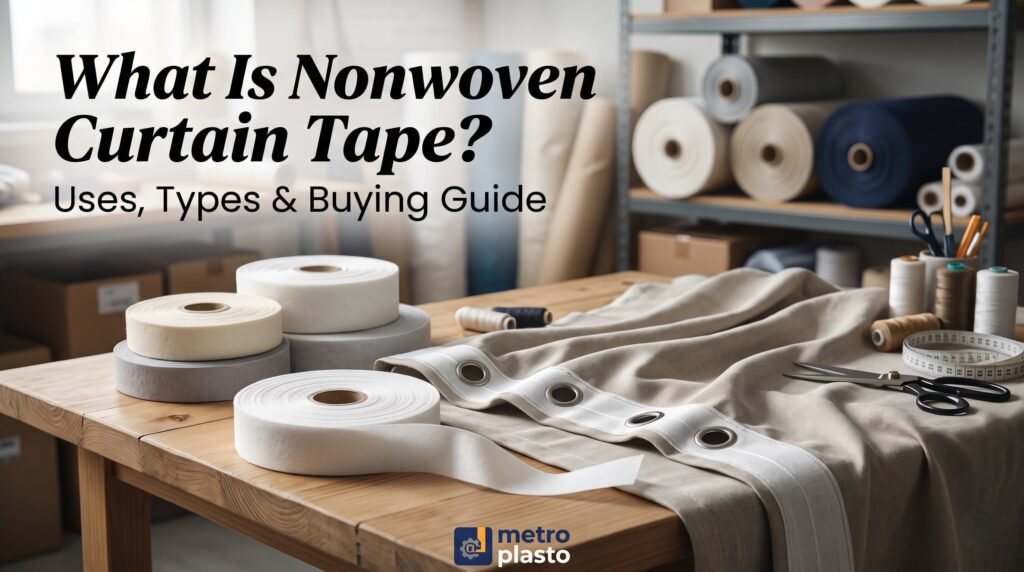
The top of the curtain decides how well it hangs. Most of the crisp eyelet and pleated curtains are supported by a simple stiffening strip known as curtain tape. This article is intended for curtain makers and furnishing companies as well as fabric buyers who want to learn about the applications of nonwoven curtain tape, the main types, and what to check before buying in bulk.
Quick answer: Nonwoven curtain tape is a stiff strip made up of nonwoven fabric stitched or fused at the top of the curtain. This gives strength and support to the header of the curtain so that it hangs in an accurate manner, retains pleats, and has eyelets without sagging. When purchasing the right tape, you need to check the following: size, stiffness, type, and color of the tape and make sure that these details correspond to your curtain design.
What Is NonWoven Curtain Tape?
Nonwoven curtain tape, also called curtain buckram or header tape, is a narrow strip of fabric used to stiffen the top of a curtain.
It is made from nonwoven fabric, usually polypropylene (PP) or polyester. Instead of being woven on a loom, the fibers are bonded together by heat, pressure, or chemicals. This gives a firm, even sheet that can be cut into strips without fraying.
The tape sits inside the folded top hem of the curtain. Once stitched or fused in place, it:
- Keeps the header straight and upright
- Supports eyelets, hooks, or pleats
- Stops the top of the curtain from sagging or curling
Example: Without tape, eyelet rings in a light curtain may pull the fabric out of shape. The tape holds the rings in place, and the folds lie flat.
Types of NonWoven Curtain Tape and Key Specifications
| Type | How it works | Best for |
| Sew in tape | Stitched into the curtain header | Most fabrics; easy to remove or replace |
| Fusible tape | Has a heat activated adhesive and is ironed or pressed in | Quick production; fabrics that can take heat |
| Eyelet tape | Firm tape suited to punching eyelet holes | Eyelet (ring top) curtains |
| Pleat tape | Stiff tape that holds handmade or pinch pleats | Pinch pleat and box pleat curtains |
Specifications to check:
| Specification | What to check |
| Width | Matches your header height |
| GSM | Higher GSM usually means stiffer tape |
| Colour | Should not show through the fabric |
| Roll length | Enough for your production needs |
| Material | PP or polyester; check heat and wash suitability |
NonWoven Curtain Tape Uses in Curtain Making
The main purposes of nonwoven curtain tape uses can be summarised as follows:
- Eyelet curtains: This type of tape provides enough structure to the top edge to accommodate eyelet chains of plastic or metal.
- Pinch pleat and box pleat curtains: The tape is responsible for holding the pleats in their place.
- Rod pocket curtains: The tape adds stiffness to the area where the top gathers.
- Valances and pelmets: Due to the stiffness of the tape, the decorative areas hold their shape.
- Blinds and other furnishings: Some manufacturers use the tape for stiffening the parts of Roman shades.
How it is applied (sew in tape):
- Cut the tape according to the width of the curtain.
- Insert the tape inside the top hem.
- Fold the hem over the tape and directly sew along the upper and lower edges.
- Create the eyelets or pleats as necessary.
Example: if a furnishing store produces curtains with eyelets in bulk, it might select a firm, thicker tape to ensure the uniformity of curtains after the installation of the eyelets.
Performance Factors and Trade-offs
| Factor | Trade-off to consider |
| Stiffness | Stiffer tape holds shape better but can feel rigid on light, flowing fabrics |
| Width | Wider tape gives a bolder header but uses more material per curtain |
| Sew-in vs fusible | Fusible is faster to apply; sew-in suits heat sensitive fabrics and is easier to replace |
| Washability | Some tapes may soften or lose shape after repeated washing; check the supplier’s guidance |
| Heat tolerance | PP based tape can be sensitive to high heat, so ironing temperature matters |
| Colour shows through | White tape may show through thin or dark fabrics; choose a matching colour |
Example: A heavy blackout curtain may need a firmer, wider tape to support its weight, while a sheer curtain usually works better with a lighter tape that does not show through.
How to Choose the Right Curtain Tape and Supplier
Good material selection starts with your curtain, not the tape:
- Header style: eyelet, pinch pleat, rod pocket, or valance.
- Fabric weight: Heavy fabrics typically need sturdy tape.
- Application method: Choose between sew-in and fusible tape according to your fabric and manufacturing process.
- Width and GSM: Ensure both dimensions match the height of the header and desired level of stiffness.
- Colour: Pick the colour that does not show through the curtain fabric.
- Test first: Create a sample curtain and wash it and put it on hold before buying in bulk.
When choosing a supplier, check for:
- GSM, width, and stiffness are consistent across the whole series.
- specifications mentioned on the invoice or quotation
- samples before the bulk purchase.
- reliable roll lengths and packaging units.
- Enough quantity is available, and delivery times are well established.
The quality of the base nonwoven fabric defines the performance of the tape, so it helps to know what it is made from and how consistent it is across fabric applications.
Quality Checks and Handling
Quality checks on delivery:
- GSM: Check the weight of a piece and check it with the specified GSM.
- Width: Measure at different places of the roll.
- Stiffness: Physically check that the stiffness is the same as for the approved sample.
- Surface: Check for holes, thin points, stains, or improper adhesion.
- Edges: The edges must be firm and straight, without fraying.
- Fusible tapes: Try a small piece of tape on your fabric to check the adhesion and presence of heat marks.
Storage and handling:
- Storing rolls flat or vertically in a cool, dry place without direct sun.
- Keep rolls packed to avoid dirt and moisture.
- Prevent crushing of rolls because it can show in the final header.
- Use older stock first.
Common Mistakes to Avoid
- Choosing tape by price alone: Low-GSM tape could be soft so that eyelets or pleats could be left without support.
- Using one tape for every curtain: Light and blackout curtains need different levels of stiffness.
- Ironing fusible tape too hot: Excess heat could wreck PP tape and/or burn the fabric; conduct tests first.
- Ignoring show through: Transparent tape could become visible through thin/dark coloured fabrics.
- Skipping a wash test: For some tapes, washing would make the tape softer, and it is better to test before making a bulk purchase.
- Not getting specs in writing: Finally, ensure that the GSM, width, length of the roll, and colour are specified in the contract.
FAQs
What is nonwoven curtain tape used for?
It provides stiffness at the top of a curtain so that the header remains straight. Moreover, curtain tape helps carry eyelets, pleats, or hooks evenly.
How do I choose the right curtain tape?
You need to consider the width, GSM, kind (sew-in and fusible), and colour and match it with the style and fabric of your curtain. It is recommended to test first.
Which specifications or quality checks matter most?
GSM, width, stiffness, roll length, colour, and consistency between batches.
How should curtain tape be stored and handled?
Store all rolls wrapped in a cool, dry area far from sunlight. Make sure they are not pressed. Always use the older stock first.
Conclusion
The main nonwoven curtain tape uses are simple: it shapes, supports and finishes curtains properly. To find the proper tape, you must match its type, thickness, GSM, and colour to the type of fabric used for curtains and check the sample and specifications in writing.
Are you searching for a good-quality nonwoven fabric for curtain tape or other items? Explore Metro Plasto’s PP spunbond nonwoven fabric, or contact us for samples and bulk supply details.