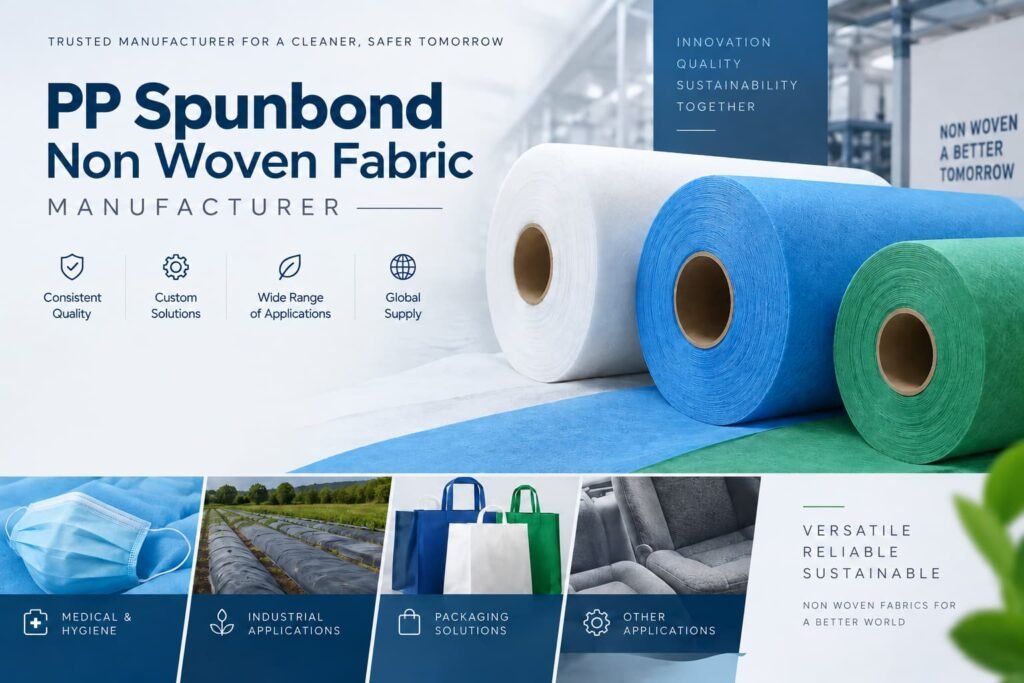
Every roll of PP spunbond non woven fabric starts with polypropylene resin, which is melted and formed into continuous filaments. What differentiates one manufacturer’s fabric from another is the control of the manufacturing process, GSM consistency, bonding method, finishing, treatments, and ability to maintain specifications from one production run to the next.
Metroplasto is a PP spunbond non woven fabric manufacturer providing PP spunbond non woven fabric for applications across hygiene, medical, packaging, agriculture, industrial, automotive, and home-textile sectors. This guide explains how PP spunbond fabric is manufactured, which specifications matter, how different treatments work, and what buyers should consider when selecting a manufacturer.
What Is PP Spunbond Non Woven Fabric?
PP spunbond non woven fabric is a sheet material made from polypropylene (PP) fibres that are extruded, laid into a web, and bonded together without weaving, knitting, or stitching.
The term “spunbond” refers to the manufacturing process in which continuous polymer filaments are spun and bonded directly into a web. Unlike traditional woven fabrics, spunbond non woven fabric does not use interlaced yarns.
This construction gives PP spunbond fabric several useful characteristics, including:
- Lightweight construction
- Good strength-to-weight ratio
- Breathability
- Resistance to water absorption in its untreated form
- Chemical resistance
- Durability
- Processability for cutting, stitching, bonding, and converting
Polypropylene is also a recyclable thermoplastic, although recycling options can vary depending on coatings, laminations, treatments, and contamination.
PP spunbond fabric should also be distinguished from PP woven fabric. PP woven fabric is produced by weaving tapes or yarns on a loom, while spunbond fabric is produced by bonding continuous filaments into a non woven structure.
How PP Spunbond Non Woven Fabric Is Made
The exact equipment and production parameters can vary between manufacturers, but the basic manufacturing process generally follows these stages:
1. Polymer Extrusion
Polypropylene resin is fed into an extruder, where controlled heat melts the polymer. The material is processed under controlled conditions to create a consistent polymer melt suitable for filament production.
Maintaining consistent processing conditions is important because variations can affect filament formation, fabric uniformity, and final mechanical properties.
2. Filament Spinning
The molten polymer is pushed through a spinneret containing numerous small openings. This produces continuous polypropylene filaments.
The filaments are then cooled using controlled airflow before being stretched to achieve the required fibre characteristics.
3. Filament Drawing and Web Formation
The filaments are drawn to improve orientation and strength and then distributed across a moving surface to form a continuous web.
The distribution of filaments affects fabric uniformity and contributes to consistent GSM across the roll.
4. Thermal Bonding
The loose web is bonded to create a stable fabric structure. Thermal calendering is commonly used, where heated rollers apply controlled pressure and heat to bond the filaments.
The bonding conditions influence important characteristics such as:
- Tensile strength
- Softness
- Stiffness
- Surface appearance
- Dimensional stability
5. Finishing and Roll Winding
After bonding, the fabric can be finished, treated, slit, or laminated depending on the application.
The finished fabric is then wound into rolls according to the required width, length, weight, and packaging specifications.
Specifications That Matter: GSM, Width, and Colour
When purchasing PP spunbond non woven fabric, buyers should pay close attention to GSM, width, colour, and the required physical properties.
GSM
GSM means grams per square metre and represents the fabric’s basis weight. It is one of the most important specifications when selecting non woven fabric.
As a general guide:
| Approximate GSM | Common Applications |
| 9–25 GSM | Hygiene-product components and lightweight disposable applications |
| 25–80 GSM | Bags, packaging, wraps, medical drapes and gowns |
| 80–150 GSM | Upholstery, mattress backing and heavier applications |
| 150 GSM and above | Agricultural, geotextile and industrial applications |
These ranges are general guidelines. The appropriate GSM depends on the finished product, required strength, converting process, durability, and application requirements.
Width
Fabric width directly affects production efficiency and material utilisation.
Wider rolls can be useful for large-format applications such as agricultural covers and geotextiles, while narrower or slit rolls may be more suitable for smaller converting machines.
Before ordering, buyers should confirm the required roll width with the manufacturer based on their equipment and finished-product dimensions.
Colour
PP spunbond fabric can be produced in different colours using suitable pigment masterbatch during the extrusion process.
For custom-colour orders, buyers should confirm colour requirements, acceptable tolerances, minimum order quantities, and sample approval procedures before production.
Functional Treatments and Finishes
PP spunbond non woven fabric can be modified with functional treatments to provide specific performance characteristics.
| Treatment | Function | Typical Applications |
| Hydrophilic | Improves liquid absorption or wetting | Diaper and sanitary-product components |
| Hydrophobic | Improves liquid repellence | Protective products and moisture-resistant applications |
| UV Stabilised | Helps resist degradation from prolonged sunlight exposure | Agricultural and outdoor applications |
| Flame Retardant | Helps reduce ignition and flame spread | Automotive and selected industrial applications |
| Anti-static | Helps dissipate static charge | Electronics packaging and industrial applications |
| Antimicrobial | Helps inhibit microbial growth on the fabric surface | Selected medical and hygiene applications |
| PE/PP Lamination | Adds a film layer for increased barrier performance | Packaging and selected protective applications |
The suitability of a particular treatment depends on the final product and required performance. Buyers should confirm technical specifications and testing requirements before placing a bulk order.
Where PP Spunbond Non Woven Fabric Is Used
PP spunbond non woven fabric is used across a wide range of industries because its properties can be adjusted for different applications.
Hygiene and Medical Applications
PP spunbond fabric is widely used in disposable hygiene and medical products because of its lightweight structure, breathability, softness, and versatility.
Applications include:
- Surgical gowns
- Surgical drapes
- Medical caps
- Shoe covers
- Face-mask components
- Disposable bed sheets
- Diaper components
- Sanitary-product components
- Other disposable hygiene products
For medical applications, buyers should confirm GSM, tensile strength, barrier properties, applicable standards, and required test documentation. Explore medical non woven fabric buyer guide
Packaging and Shopping Bags
PP spunbond fabric is commonly converted into reusable shopping bags, promotional bags, tote bags, gift bags, exhibition bags, and protective packaging.
The material can be cut, stitched, printed, laminated, and converted into different bag designs.
The required GSM depends on bag size, construction, handle design, expected load, and intended service life.
Explore medical non woven fabric buyer guide
Agriculture
PP spunbond fabric is used for several agricultural applications, particularly where lightweight protection and controlled air and moisture movement are required.
Common uses include:
- Crop covers
- Frost protection covers
- Weed-control fabrics
- Nursery bags
- Plant protection products
- Agricultural ground covers
- Mulching applications
UV stabilisation is an important consideration for fabrics that will remain outdoors for extended periods.
Home Textile and Furnishing
PP spunbond non woven fabric can be used as a backing or supporting material in products such as:
- Mattress backing
- Upholstery backing
- Carpet backing
- Furniture components
- Curtain interlining
- Protective covers
Automotive and Industrial Applications
Heavier grades can be used for applications such as:
- Automotive interior linings
- Trunk liners
- Industrial packaging
- Protective covers
- Construction underlays
- Filtration support layers
- Technical textile components
For specialised applications, the fabric should be selected according to the required mechanical, environmental, and processing properties.
PP Spunbond vs. Meltblown vs. SMS Non Woven Fabric
Spunbond, meltblown, and SMS are different non woven structures designed to provide different performance characteristics.
Spunbond
Spunbond fabric is produced from continuous filaments. It generally provides good tensile strength, durability, and breathability.
It is commonly used for:
- Bags
- Medical products
- Hygiene products
- Agriculture
- Packaging
- Industrial applications
Meltblown
Meltblown fabric is produced using much finer fibres than conventional spunbond fabric.
Its dense fibre structure makes it suitable for applications where filtration and barrier properties are important. However, meltblown fabric generally has lower structural strength than spunbond fabric when used alone.
SMS
SMS stands for spunbond-meltblown-spunbond.
The construction combines spunbond layers with a meltblown middle layer. This allows the material to combine structural strength with filtration and barrier characteristics.
SMMS structures use two meltblown layers between spunbond layers for applications requiring additional filtration or barrier performance.
The right material depends on the specific requirements of the finished product.
How to Evaluate a PP Spunbond Non Woven Fabric Manufacturer
When comparing PP spunbond non woven fabric manufacturers, buyers should evaluate more than the quoted price.
Production Capability and Quality Certifications
Ask whether the supplier manufactures the fabric in its own facility or sources it from another producer.
A direct manufacturer may provide greater visibility into production parameters, quality control, customisation, and supply planning.
Buyers should also ask about:
- GSM tolerance
- Tensile strength
- Fabric uniformity
- Raw-material specifications
- Quality-control procedures
- Material test reports
- Available certifications
ISO 9001 is commonly used to demonstrate a documented quality-management system, while OEKO-TEX Standard 100 relates to testing for specified harmful substances.
However, certification requirements depend on the intended application and target market. Always request current documentation directly from the supplier.
Customisation, MOQ, and Lead Time
Before placing an order, confirm whether the manufacturer can provide the required:
- GSM
- Width
- Colour
- Surface treatment
- Roll size
- Slit width
- Packaging format
Also ask about minimum order quantities, sample availability, production lead times, and repeat-order requirements.
These factors can be especially important for B2B buyers who require consistent specifications over multiple orders.
Getting a Sample or Quote from Metroplasto
If you are sourcing PP spunbond non woven fabric, providing detailed requirements can help the manufacturer recommend a suitable specification and prepare an accurate quotation.
When contacting Metroplasto, consider sharing:
- Required GSM
- Fabric width
- Colour
- Application
- Required treatment
- Roll size
- Estimated order quantity
- Expected monthly or annual requirement
A sample can then be evaluated for appearance, GSM, strength, converting performance, and suitability for the final product before proceeding with larger production quantities.
Frequently Asked Questions
What GSM of PP spunbond non woven fabric is suitable for shopping bags?
The appropriate GSM depends on the bag size, design, handle construction, expected load, and intended reuse. Many reusable shopping bags use medium to heavy GSM fabric, but the exact specification should be selected based on the required load-bearing performance and tested before bulk production.
What is the difference between spunbond and meltblown non woven fabric?
Spunbond fabric is made from continuous filaments and is generally designed for strength, durability, and breathability. Meltblown fabric uses much finer fibres and is commonly used where high filtration performance is required.
Is PP spunbond non woven fabric recyclable?
PP spunbond fabric is made primarily from polypropylene, which is a recyclable thermoplastic. Recycling availability depends on local collection systems, contamination, additives, treatments, and whether the fabric has been combined with other materials.
What widths are available for PP spunbond non woven fabric?
Available widths depend on the manufacturer’s production equipment and order requirements. Narrow slit rolls can also be produced for specific converting applications. Contact Metroplasto with your required width to confirm availability.
Can PP spunbond fabric be used outdoors for agriculture?
Yes, PP spunbond fabric can be used for various agricultural applications. However, outdoor applications require consideration of UV exposure. UV-stabilised fabric may be recommended when the product is expected to remain exposed to sunlight for an extended period.
What is the MOQ for PP spunbond non woven fabric from Metroplasto?
MOQ depends on factors such as GSM, width, colour, treatment, roll specifications, and total order quantity. Contact the Metroplasto team with your requirements to confirm the applicable MOQ and lead time.
Does Metroplasto supply PP spunbond fabric in custom colours?
Custom colours can be discussed according to the required specification. PP-compatible colour masterbatch can be used during production to achieve the required colour.