
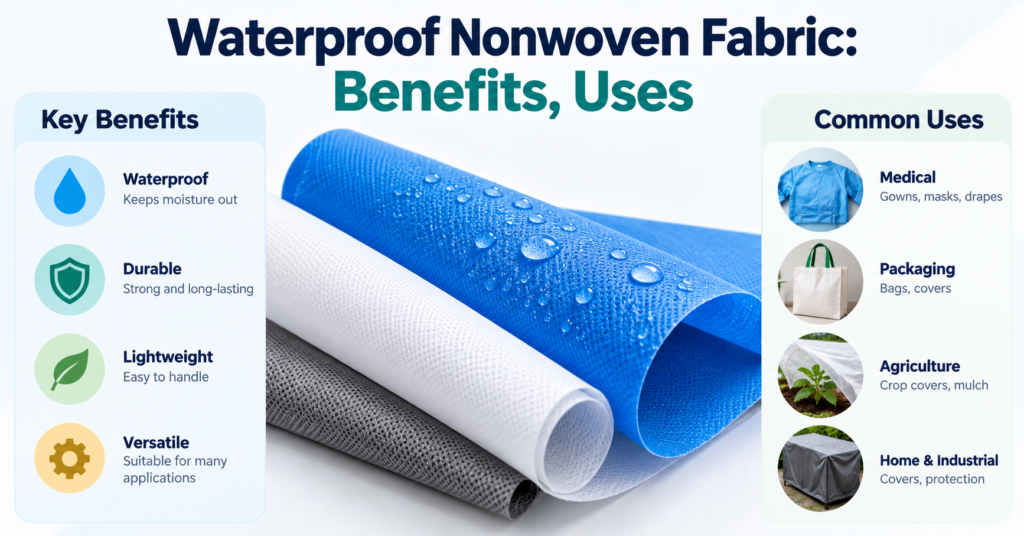
Standard nonwoven fabric is lightweight and strong but lacks total waterproof attributes. Therefore, should a product seek total protection from moisture or rain, the manufacturers will utilise waterproof nonwoven fabric.
Quick answer: Waterproof nonwoven fabric is a specific kind of material that is treated or coated to block the water entry through it. This high quality fabric is used for the manufacture of waterproof shopping bags, cushioned packaging, crop covers, and medical barrier goods, as well as furniture sheathing and industrial protection.
What Is Waterproof Nonwoven Fabric?
Nonwoven fabric is created by joining the fibres together without weaving. In its natural form, ordinary PP spunbond fabric possesses certain water repellant qualities in that polypropylene does not hold moisture, although water might flow through the small spaces between its fibres.
Waterproof nonwoven fabric features an additional treatment or layer that closes these gaps off, resulting in a material that prevents water from getting to the other side under pressure.
How Is Waterproof Nonwoven Fabric Made?
Three common processes can be distinguished as follows:
- Lamination: Plastic film, usually made of PP or PE, is bonded to non-woven material using thermal processing. This is the most common method for bags and packaging.
- Coating: A liquid polymer is coated onto one side of the fabric and dried, making it completely waterproof.
- Combination of multi-layer barriers: Stacking the layers in any combination, such as spunbond-meltblown-spunbond, helps improve the barrier performance of the finished materials. This method is mainly used for medical and hygiene products.
Key Benefits of Waterproof Nonwoven Fabric
- Water resistant: Prevents the intrusion of water and any other form of moisture.
- Durable: More layers of softening fabric make it very durable and tear-resistant.
- Easy to clean: Laminated surfaces only require cleaning using the softest cloths.
- Good printing: Smooth laminate helps printing become better when producing pictures.
- Lightweight: One of the lightest water-resistant materials around.
- Inexpensive: Provides waterproof protection with low cost.
- Flexible: Easy to cut, sew, and seal different membranes.
Common Uses of Waterproof Nonwoven Fabric
- Packaging: We provide protective wrapping solutions through the use of suitable moisture-sensitive materials. See our nonwoven fabric for packaging.
- Shopping bags: We specialise in laminated bags and treated materials that offer additional moisture protection. Explore our fabric for nonwoven bags.
- Agriculture: We provide farm covers and other moisture protection solutions, specifically designed to be used outdoors. See our agricultural fabrics.
- Medical and hygiene products: We produce speciality barrier materials, ensuring they comply with all the necessary requirements. See our medical and hygiene fabrics.
- Furniture and construction: We provide covers and underlays suitable for layout specifications.
- Industrial applications: We specialise in using safety and coverage solutions with regard to surface and product parks.
Waterproof vs Water Resistant Nonwoven Fabric
| Factor | Water resistant | Waterproof |
| What it means | Repels light moisture and splashes | Blocks water from passing through |
| How it is made | Plain PP spunbond or water-repellent treatment | Lamination, coating or barrier layers |
| Breathability | Breathable | Usually low, unless a breathable film is used |
| Feel | Soft and fabric-like | Smoother and slightly stiffer |
| Cost | Lower | Higher |
| Best for | Everyday bags, light covers | Laminated bags, protective packaging, barrier products |
How to Choose the Right Waterproof Nonwoven Fabric
- Define the exposure: Are you dealing with rain, splashes or continuous water immersion?
- Pick the method: Utilise lamination technologies for bags and packaging work. Apply barrier fabrics for any medical or hygiene purpose products.
- Choose the GSM: the higher the GSM, the more durable the item is, but the price will also increase.
- Check breathability: If airflow is necessary for the product, check for breathable options.
- Consider printing: laminated surfaces are easy to print in branded bags.
- Confirm standards: Rest assured that the medical and hygiene items are certified according to the required standards.
- Test samples: Test for strength and waterproofness before proceeding with bulk orders.
Is Waterproof Nonwoven Fabric Suitable for Bags and Packaging?
Yes. Laminated nonwoven fabric is widely used for shopping bags and promotional bags, as well as for protective packaging. It helps keep contents dry, has a premium look, prints well, and is much stronger than plain fabric. Make sure to choose a suitable GRM and good stitching for bags that carry heavy items. Metro Plasto supplies laminated nonwoven fabric made for these uses.
Is Waterproof Nonwoven Fabric Reusable and Recyclable?
Reusable: Yes. Laminated nonwoven bags and covers are long-lasting and can be wiped clean and reused several times.
Recyclable: Polypropylene is a recyclable polymer, but its recycling depends on local recycling units. Generally, fabric laminated with the same material (PP on PP) is more easily recycled than that combined with another plastic. The best way to minimise waste is to keep using products for a long time.
How to Choose a Reliable Nonwoven Fabric Supplier
A dependable nonwoven fabric supplier should offer:
- Clear specifications: GSM, width, shading, finishing, and composition.
- Quality raw materials: Ideally 100% virgin polypropylene.
- Samples: To test water resistance and strength before bulk order.
- Consistency in quality: Same performance in the repeat order.
- Clear MOQ and delivery schedule: There should be no deal breakers with order size and dispatch time.
- Technical support: Assistance in selection of appropriate fabric.
Metro Plasto is a trusted nonwoven fabric manufacturer in India, producing PP spunbond nonwoven fabric in Bhiwani, Haryana, since 2011. Our fabric is made from 100% virgin polypropylene and is available in various colours for bags, packaging, and agricultural and medical applications. We also provide laminated nonwoven fabric for waterproof bags, packaging, and protection. Consult our experts regarding the suitable GSM and finishing you need.
Frequently Asked Questions
What makes nonwoven fabric waterproof?
Nonwoven materials become waterproof through lamination with polypropelene or polythene film or through applying a film coat or using barrier layers such as SMS.
What is the difference between waterproof and water resistant nonwoven fabric?
Water resistant materials prevent light moisture but allow water to seep through with pressure, while waterproof materials do not let water in.
Is laminated non-woven fabric suitable for shopping bags?
Absolutely. It is a durable and moisture resistant material that is easy to clean and prints beautifully.
Can waterproof nonwoven fabric be reused?
Yes. You can wash laminated bags and covers and reuse them many times.
How can I check the water resistance of nonwoven material?
For a quick check, place water on the fabric or fill a sample bag with water and look for leaks. For formal results, ask the supplier for hydrostatic pressure test data.
Is waterproof, nonwoven fabric breathable?Is waterproof, nonwoven fabric breathable?
Most likely, it does not. Usually, laminated materials block air as well as water. Breathable versions use special microporous films that let vapour out but keep water out.
Conclusion
Waterproof nonwoven fabric is an excellent choice for applications such as laminated shopping bags, protective wrapping, crop covers, vapour barriers, and protective tarpaulin covers. Select the best option in terms of method, GSM, and permeability, and always remember to first perform testing on samples.
Looking for quality nonwoven fabric for your next project? Contact Metro Plasto for samples and a quick quote.