
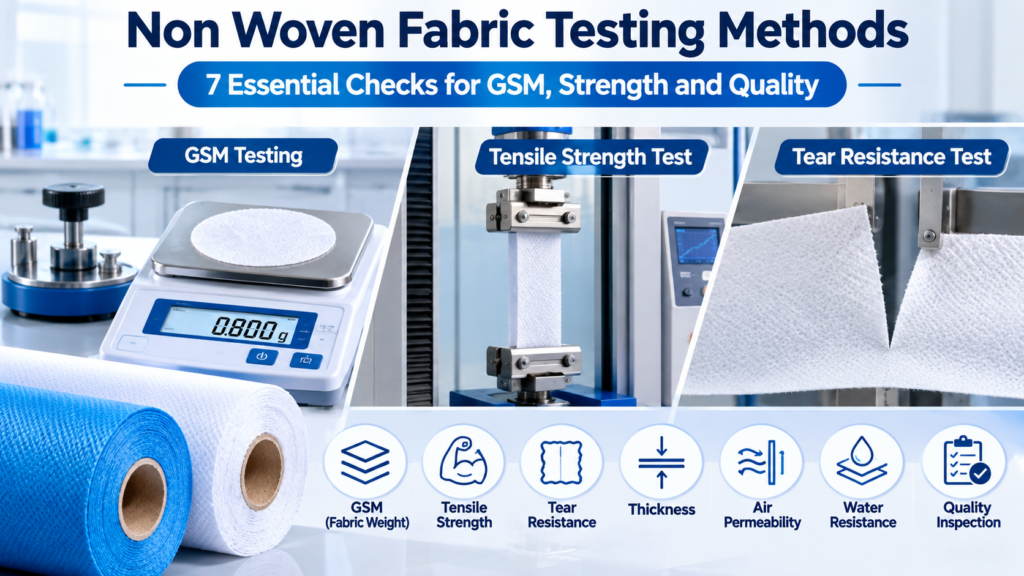
Understanding non woven fabric testing methods is important for manufacturers, procurement teams and businesses purchasing fabric rolls for packaging, healthcare, agriculture, furniture and other industrial applications.
The performance of non woven fabric depends on its raw material, fibre arrangement, bonding quality, GSM, thickness and manufacturing consistency. Two fabrics with the same weight may have different strength, flexibility, breathability and durability.
Quality testing helps manufacturers evaluate these differences before approving materials for bulk production.
This guide explains seven essential fabric testing methods, how GSM is calculated, how tensile strength differs from tear resistance, and what buyers should check when purchasing non woven fabric rolls.
What Is Non Woven Fabric Testing?
Non woven fabric testing involves evaluating the physical, mechanical and functional characteristics of a fabric to determine whether it meets specified requirements.
Unlike conventional woven textiles, nonwoven materials are produced by bonding or mechanically interlocking fibres or filaments into a fabric structure.
In PP spunbond manufacturing, polypropylene filaments are formed into a web and bonded to produce fabric sheets. Variations in filament distribution, bonding conditions and production parameters can influence the finished material’s properties.
For more information about this process, read our guide to PP spunbond non woven fabric manufacturing.
Testing helps buyers assess whether the material is suitable for its intended application and whether supplied batches meet agreed specifications.
Why Are Non Woven Fabric Testing Methods Important?
Fabric testing provides measurable information that helps manufacturers make informed material selection and purchasing decisions.
The main objectives include:
- Checking fabric weight and dimensional consistency.
- Evaluating mechanical strength and elongation.
- Identifying differences between production batches.
- Verifying suitability for cutting, stitching, bonding and converting.
- Evaluating application-specific functional properties.
- Reducing the risk of accepting unsuitable material.
- Supporting consistent quality in finished products.
Testing requirements should be selected according to the intended application rather than applying identical acceptance limits to every fabric grade.
7 Essential Non Woven Fabric Testing Methods
The following table summarizes the main quality checks used when evaluating nonwoven materials.
| Testing Method | What It Measures | Typical Equipment or Reference |
| GSM testing | Fabric mass per unit area | Sample cutter and precision balance; ISO 9073-1 |
| Tensile strength testing | Force and elongation at break | Tensile testing machine; ISO 9073-3 |
| Tear resistance testing | Resistance to tearing under specified conditions | Trapezoid tear test; ISO 9073-4 |
| Thickness testing | Fabric thickness under specified pressure | Thickness gauge; ISO 9073-2 |
| Air permeability testing | Airflow through a defined fabric area | Air permeability tester; ISO 9073-15 |
| Water penetration resistance testing | Resistance to water passing through the material | Hydrostatic pressure tester; ISO 9073-16 |
| Visual quality inspection | Surface defects and visible irregularities | Inspection table and agreed defect criteria |
The appropriate methods and acceptance limits depend on the fabric construction, customer requirements and intended finished product.
1. GSM Testing of Non Woven Fabric
GSM testing determines the mass of fabric per square metre. GSM stands for grams per square metre and is one of the most commonly specified properties when purchasing non woven fabric rolls.
The ISO 9073-1:2023 standard describes a method for determining the mass per unit area of nonwoven materials.
GSM consistency is important because variations in material weight may affect the appearance, handling and performance of the finished product.
A fabric roll should be evaluated using representative samples rather than relying on a single measurement.
GSM of Fabric Formula
The GSM of fabric formula is:
GSM = Sample weight in grams ÷ Sample area in square metres
For a sample measuring exactly 10 cm × 10 cm, the area is 0.01 square metres.
Therefore, for this sample size:
GSM = Sample weight in grams × 100
For example, if a 10 cm × 10 cm fabric sample weighs 0.80 grams:
GSM = 0.80 × 100 = 80 GSM
This calculation indicates that the sample has a mass per unit area of 80 grams per square metre.
Non Woven Fabric GSM Calculation Chart
| Sample Size | Sample Weight | Calculated GSM |
| 10 cm × 10 cm | 0.20 g | 20 GSM |
| 10 cm × 10 cm | 0.40 g | 40 GSM |
| 10 cm × 10 cm | 0.60 g | 60 GSM |
| 10 cm × 10 cm | 0.80 g | 80 GSM |
| 10 cm × 10 cm | 1.00 g | 100 GSM |
| 10 cm × 10 cm | 1.50 g | 150 GSM |
| 10 cm × 10 cm | 2.00 g | 200 GSM |
These are illustrative calculations, not actual Metro Plasto laboratory results or recommended GSM values for specific products.
For reliable acceptance testing, use accurately measured samples, calibrated equipment and the conditioning and sampling requirements of the agreed test method.
GSM measures mass per unit area. It does not directly measure fabric thickness, tensile strength or durability.
2. Fabric Tensile Strength Test
A fabric tensile strength test evaluates how a material responds when subjected to a pulling force.
During a strip tensile test, a prepared fabric specimen is held between two grips and extended under controlled conditions until it breaks.
The test records properties such as breaking force and elongation at break.
The ISO 9073-3:2023 standard describes tensile and elongation testing for nonwoven materials using the strip method.
Non woven fabric may have different mechanical properties in two main directions:
- Machine direction (MD): The direction in which the fabric travels during manufacturing.
- Cross direction (CD): The direction perpendicular to the machine direction.
Manufacturers should evaluate both directions where relevant because fibre orientation and bonding may influence the test results.
For example, a fabric used in garment covers may need sufficient strength in the directions subjected to loading during handling. The actual requirements depend on the cover design, seam construction and expected usage.
When comparing tensile strength reports, confirm that the test method, specimen dimensions, conditioning and testing direction are consistent.
3. Tear Resistance Testing
Tear resistance testing measures how a fabric responds when a tear is initiated and extended under specified test conditions.
It is different from tensile strength testing, which evaluates the material’s response to stretching and breaking under a pulling force.
The ISO 9073-4:2021 standard describes the trapezoid method for determining tear resistance in nonwoven materials.
Tear resistance is particularly relevant when evaluating fabric used in products that may experience localized damage, punctures or stress concentrations.
Examples include shopping bags, garment covers, packaging materials and selected industrial textile components.
A fabric with good tensile performance may still respond differently when a tear begins at a cut or damaged area.
For that reason, tensile strength and tear resistance should be evaluated separately where both properties are important.
Businesses manufacturing packaging products can explore our non woven fabric for shopping bag manufacturing and discuss the mechanical requirements of their intended products.
4. Thickness Testing
Thickness testing measures the distance between the upper and lower surfaces of a fabric under defined measurement conditions.
The ISO 9073-2 standard provides a method for determining nonwoven fabric thickness.
Thickness is commonly reported in millimetres and can influence material handling, flexibility, bulk and compatibility with converting machinery.
Fabric thickness depends on several factors, including:
- Fibre or filament arrangement.
- Bonding method.
- GSM.
- Material density.
- Compression characteristics.
Two fabrics with identical GSM may have different thicknesses because their constructions differ.
Manufacturers should therefore specify both GSM and thickness when these properties are important to the finished product.
5. Air Permeability Testing
Air permeability testing measures the airflow passing through a defined area of fabric under specified pressure conditions.
The ISO 9073-15 standard describes an air permeability test method for nonwoven materials.
This property can be important in products requiring controlled airflow or ventilation.
Examples include selected agricultural covers, garment storage products, hygiene components and filtration materials.
Air permeability depends on fibre arrangement, bonding, thickness, pore structure and surface treatments.
A highly air-permeable fabric is not automatically suitable for every application. Products requiring barrier performance or controlled filtration may have different requirements.
Buyers should agree on the required airflow characteristics and test conditions with their supplier.
6. Water Penetration Resistance Testing
Water penetration resistance testing evaluates a fabric’s ability to resist liquid water passing through its structure under specified conditions.
The ISO 9073-16 standard describes a method for assessing resistance to water penetration using hydrostatic pressure.
Although polypropylene has low inherent moisture absorption, a nonwoven fabric made from polypropylene is not automatically waterproof.
Water may pass through openings in the fabric structure depending on its construction, bonding and surface treatments.
Manufacturers should distinguish between:
- Moisture absorption by the fibres.
- Surface water repellency.
- Resistance to liquid penetration.
- Waterproof performance of a finished assembly.
Each property requires appropriate evaluation.
Products intended for medical, protective or specialized barrier applications may require additional tests and regulatory verification beyond general fabric testing.
7. Visual Quality Inspection
Visual inspection helps identify surface defects, manufacturing inconsistencies and damage that may affect material conversion.
Typical inspection points include:
- Holes and visible weak areas.
- Uneven fabric distribution.
- Stains and contamination.
- Colour variation.
- Wrinkles and damaged roll edges.
- Visible bonding defects.
- Inconsistent winding or packaging.
Manufacturers should agree on acceptable defect types, inspection conditions and rejection criteria before placing bulk orders.
Visual inspection is useful for identifying obvious problems, but it should not replace mechanical or functional testing when measurable performance requirements apply.
Difference Between GSM, Tensile Strength and Tear Resistance
GSM, tensile strength and tear resistance are commonly discussed together, but they represent different properties.
| Property | What It Measures | Common Reporting Unit | Why It Matters |
| GSM | Mass per unit area | g/m² | Fabric weight and material consistency |
| Tensile strength | Resistance to pulling until failure | Newtons or force per specified specimen width | Mechanical performance under tension |
| Elongation at break | Extension before breaking | Percentage | Stretching and deformation behaviour |
| Tear resistance | Resistance to tear propagation under specified conditions | Newtons | Response to an initiated tear |
| Thickness | Fabric thickness | Millimetres | Bulk and dimensional compatibility |
Higher GSM may improve some properties in comparable fabric constructions, but it does not automatically guarantee higher tensile strength or tear resistance.
The appropriate material must be selected using measured performance and application-specific requirements.
How to Select Non Woven Fabric Testing Methods for Different Industries
Not every industrial application requires the same testing programme.
The intended function of the finished product should determine which material properties are evaluated.
| Industry | Priority Quality Checks | Additional Considerations |
| Shopping bags and packaging | GSM, tensile strength, tear resistance and appearance | Finished bag seams, handle strength and applicable regulations |
| Garment covers | GSM, opacity, strength and air permeability | Zipper attachment, seams and storage conditions |
| Agriculture | GSM, air permeability and mechanical strength | Light transmission, UV durability and outdoor exposure |
| Medical and hygiene | GSM, uniformity and application-specific liquid properties | Applicable product standards and regulatory requirements |
| Furniture and bedding | Thickness, tensile strength and tear resistance | Abrasion, seam compatibility and intended loading |
| Automotive components | Mechanical strength and dimensional consistency | Applicable OEM specifications and component-level tests |
These are general examples of test selection rather than universal industry acceptance criteria.
Manufacturers should confirm the exact test methods, limits and documentation required for their particular finished product.
How to Check Non Woven Fabric Quality Before Bulk Purchasing
Non woven fabric testing methods are most useful when combined with a clearly defined material approval process.
Before purchasing large quantities, buyers should provide the supplier with the required material specifications and expected application.
Request a Technical Data Sheet
A technical data sheet may provide information about material composition, nominal GSM, dimensions, mechanical properties and available treatments.
The exact contents vary according to the supplier and product grade.
Review the document carefully and clarify any missing properties before confirming the order.
Approve a Representative Fabric Sample
Evaluate the fabric sample using the intended manufacturing process.
For example, a packaging manufacturer may assess cutting behaviour, stitching, bonding and finished-product strength before approving a fabric grade.
An approved sample provides a useful comparison reference, but it should not replace written specifications.
Confirm Acceptance Criteria
Agree on the permitted variation in GSM, width, colour, thickness and other relevant properties.
Also confirm which testing methods will be used to assess compliance with the purchase specification.
Acceptance limits should be established according to the product requirements rather than using an arbitrary tolerance for every material.
Review Batch Testing Documentation
Where required, request a batch-specific test report or certificate of analysis.
Check whether it identifies the material grade, production batch, test methods, measurement results and applicable acceptance criteria.
A general marketing brochure is not equivalent to a batch-specific test report.
Inspect Rolls Before Production
Upon delivery, check roll identification, dimensions, packaging condition, appearance and agreed material properties.
Use a suitable sampling plan for large orders and record any differences from the approved specification.
Common Mistakes to Avoid in Non Woven Fabric Testing
Manufacturers and procurement teams should avoid the following mistakes when evaluating fabric quality:
- Selecting materials based only on GSM.
- Assuming heavier fabric is always stronger.
- Confusing tensile strength with tear resistance.
- Comparing results obtained using different test methods without checking comparability.
- Testing only one sample from a large production batch.
- Ignoring differences between machine and cross direction.
- Using visual inspection as a substitute for required laboratory tests.
- Assuming that a fabric is waterproof because it is made from polypropylene.
- Approving material without a written specification.
Recognizing these differences helps buyers select fabric according to actual performance rather than general product descriptions.
PP Spunbond Non Woven Fabric Rolls from Metro Plasto
Metro Plasto is a non woven fabric manufacturer in India based in Bhiwani, Haryana.
The company manufactures and supplies PP spunbond non woven fabric rolls for various industrial, packaging, agricultural and textile applications.
Available customization options include fabric GSM, colours, roll widths and roll lengths.
When sourcing fabric, buyers can discuss their required material properties, application, order quantity and documentation needs with the Metro Plasto team.
For further procurement guidance, explore our polypropylene nonwoven fabric buyer’s guide.
Specific test capabilities, test reports, tolerances and application-related compliance requirements should be confirmed before placing an order.
Frequently Asked Questions
What are the main non woven fabric testing methods?
Common methods include GSM testing, tensile strength testing, tear resistance testing, thickness measurement, air permeability testing, water penetration resistance testing and visual inspection.
The appropriate methods depend on the fabric and its intended application.
How do you calculate the GSM of non woven fabric?
Divide the sample weight in grams by its area in square metres.
For a sample measuring exactly 10 cm × 10 cm, multiply its weight in grams by 100 to calculate GSM.
What is the difference between tensile strength and tear resistance?
Tensile strength measures how fabric responds to pulling until failure under specified test conditions. Tear resistance evaluates how the material resists the extension of an initiated tear.
Both properties can be important when selecting materials for industrial products.
Does higher GSM mean better fabric quality?
Not necessarily. GSM measures mass per unit area, while quality depends on fibre properties, bonding, uniformity, mechanical performance and suitability for the application.
Which ISO standards are used for non woven fabric testing?
The ISO 9073 series includes methods for evaluating nonwoven fabric properties such as mass per unit area, thickness, tensile strength, tear resistance and air permeability.
The EDANA and INDA Nonwovens Standard Procedures provide additional industry testing references.
Why should non woven fabric be tested in MD and CD directions?
Fibre orientation and manufacturing processes can result in different mechanical properties in the machine and cross directions.
Testing both directions where required helps manufacturers understand how the material may respond to loading during use.
Can non woven fabric quality be checked without laboratory equipment?
Basic visual inspection and approximate GSM calculation can help identify obvious inconsistencies.
However, formal tensile, tear, permeability and other performance tests require appropriate equipment and standardized procedures.
What should I check before ordering non woven fabric rolls?
Confirm the material grade, GSM, width, length, colour, mechanical properties, applicable test requirements, order quantity and agreed acceptance criteria.
Conclusion
Understanding non woven fabric testing methods helps manufacturers and procurement teams evaluate material quality and make informed purchasing decisions.
GSM testing, tensile strength, tear resistance, thickness measurement, air permeability, water penetration resistance and visual inspection provide different information about fabric properties.
Selecting the appropriate testing programme and confirming material specifications before purchasing can help reduce the risk of production problems and unsuitable fabric selection.
Looking for customized PP spunbond non woven fabric rolls for your manufacturing requirements? Contact Metro Plasto to discuss your application, material specifications and bulk supply requirements.