
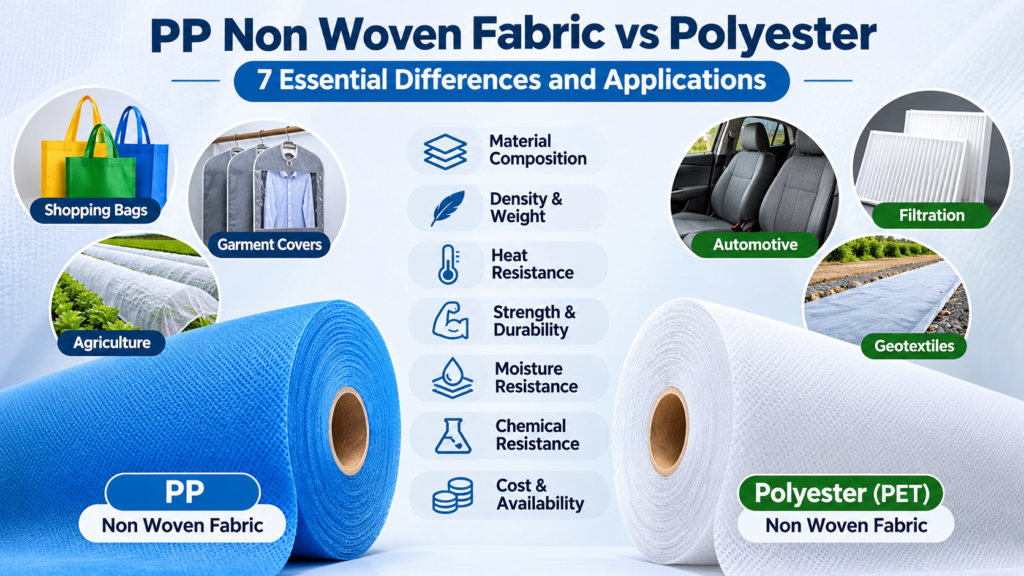
Understanding the differences between PP non woven fabric vs polyester is important for manufacturers, industrial buyers and businesses sourcing materials for packaging, healthcare, agriculture, furniture and technical textile applications.
Polypropylene (PP) and polyester are widely used synthetic polymers in non woven fabric manufacturing. Although fabrics made from these materials may appear similar, they have different physical properties, thermal characteristics and processing requirements.
Selecting the right material depends on the intended application, manufacturing process, required strength, operating conditions and production budget.
This guide compares seven essential differences between polypropylene and polyester non woven fabrics to help businesses make informed purchasing decisions.
What Is PP Non Woven Fabric?
PP non woven fabric is made from polypropylene, a thermoplastic polymer used in various textile and industrial applications.
In spunbond manufacturing, polypropylene is melted, extruded into continuous filaments, distributed into a web and bonded to produce a fabric sheet without conventional weaving or knitting.
PP spunbond fabric is commonly considered for applications requiring lightweight construction, flexibility and economical material conversion.
Its typical applications include:
- Shopping bags and packaging materials.
- Garment covers and clothing storage products.
- Selected medical and hygiene components.
- Agricultural crop covers.
- Furniture and mattress lining.
- Industrial protective covers.
The suitability of each fabric grade depends on its GSM, bonding, strength, treatments and application requirements.
For more information about its construction and manufacturing process, explore our guide to PP spunbond non woven fabric manufacturing.
What Is Polyester Non Woven Fabric?
Polyester non woven fabric is commonly manufactured using polyethylene terephthalate (PET).
Polyester fibres or filaments can be formed into a nonwoven structure through processes such as spunbond manufacturing, needle punching and thermal bonding.
PET fabrics are frequently considered for applications where thermal stability, dimensional consistency or specific mechanical properties are important.
Typical applications include selected filtration materials, automotive components, roofing substrates, geotextiles and industrial textile products.
However, polyester fabric does not automatically offer superior performance in every application. Its suitability depends on the fabric construction, material grade and operating conditions.
The EDANA nonwoven manufacturing guide provides further information about different web formation and bonding processes.
PP Non Woven Fabric vs Polyester: 7 Essential Differences
The following comparison highlights the general differences between polypropylene and PET polyester nonwoven materials.
| Comparison Factor | PP Non Woven Fabric | Polyester Non Woven Fabric |
| Material composition | Polypropylene (PP) | Polyethylene terephthalate (PET) |
| Polymer density | Approximately 0.90–0.91 g/cm³ | Approximately 1.38–1.39 g/cm³ |
| Thermal properties | Typical melting range of approximately 160–170°C | Typical melting range of approximately 250–260°C |
| Strength and durability | Depends on filament properties, GSM and bonding | Depends on filament properties, GSM and bonding |
| Moisture absorption | Very low inherent moisture absorption | Low inherent moisture absorption |
| Chemical and environmental resistance | Often suitable for selected acid and alkaline environments | Performance depends on chemical exposure and operating conditions |
| Cost and availability | Often economical for common packaging and hygiene applications | Depends on polymer grade, construction and performance requirements |
These values describe general polymer characteristics. They should not be treated as guaranteed specifications for every finished fabric.
Published research on melt-spun fibres for textile applications provides additional information about the physical and thermal properties of textile polymers.
1. Material Composition
The main difference between PP non woven fabric vs polyester is the type of polymer used during manufacturing.
Polypropylene is a polyolefin polymer, while PET belongs to the polyester family. Their different chemical structures influence how the materials respond to heat, moisture, chemicals and manufacturing processes.
Buyers should first confirm the actual polymer composition rather than relying only on the appearance or feel of a fabric sample.
2. Density and Fabric Weight
Polypropylene has a lower polymer density than PET polyester. This can be advantageous when designing products that require lightweight material construction.
However, lower polymer density does not mean that every PP fabric roll weighs less than every polyester fabric roll.
For example, a PP fabric and a polyester fabric with the same GSM have the same nominal mass per square metre. Their thickness, bulk, fibre arrangement and other properties may differ.
Manufacturers should compare both GSM and material thickness when evaluating samples.
3. Heat Resistance
PET polyester generally has a higher melting temperature than polypropylene.
This makes suitable polyester grades worth considering for applications involving elevated temperatures or processes such as heated lamination and moulding.
PP spunbond fabric may be appropriate for many packaging, garment and industrial applications where the processing temperatures remain compatible with the material grade.
The melting temperature of a polymer is not its recommended continuous operating temperature. Fabric may shrink, deform or lose mechanical performance below its melting point.
Always check the supplier’s technical data and validate the fabric under actual production conditions.
4. Strength and Durability
When comparing PP non woven fabric vs polyester, it is important to distinguish polymer properties from finished fabric performance.
Fabric strength depends on several factors, including:
- Fibre or filament characteristics.
- GSM and thickness.
- Bonding method and bonding quality.
- Fibre orientation.
- Surface treatments.
- Intended loading conditions.
Polyester may offer useful mechanical or dimensional properties in certain engineered constructions. PP spunbond can also provide suitable strength for many lightweight and industrial applications.
Compare measured tensile strength, tear resistance and elongation rather than assuming one material is always stronger.
5. Moisture Resistance and Breathability
Untreated polypropylene has very low inherent moisture absorption. Polyester also has relatively low moisture absorption compared with many natural fibres.
However, moisture absorption, water resistance and breathability describe different material properties.
A fabric can absorb very little water into its fibres while still allowing liquid to pass through openings in its structure.
Air permeability and liquid penetration depend on fibre arrangement, bonding, thickness and surface treatments.
Manufacturers requiring water resistance or controlled liquid penetration should request application-specific test results.
6. Chemical and Environmental Resistance
PP fabrics are often considered for applications involving exposure to selected acids and alkaline substances.
Polyester may be suitable for other industrial environments where its particular combination of chemical, thermal and mechanical properties meets the application requirements.
Chemical compatibility depends on the substance, concentration, temperature and exposure duration.
Outdoor applications also require consideration of ultraviolet exposure. Untreated polypropylene and polyester can degrade under prolonged environmental exposure.
UV stabilization and other treatments should be evaluated according to the intended conditions of use.
7. Cost and Manufacturing Efficiency
PP spunbond is often an economical material option for packaging, disposable components and selected industrial products.
However, fabric cost depends on several purchasing factors, including resin grade, GSM, roll dimensions, manufacturing process, treatments and order quantity.
Buyers should compare the total cost of producing the finished product rather than evaluating only the price per kilogram.
A fabric with a lower purchase price may not be economical if it results in higher cutting waste, production defects or material rejection.
Applications of PP Non Woven Fabric vs Polyester
Both materials serve different industries. The most appropriate choice depends on the specifications of the finished product.
| Industry or Application | PP Non Woven Fabric | Polyester Non Woven Fabric |
| Shopping bags and retail packaging | Commonly considered for lightweight bag construction | May be used in specialized packaging designs |
| Medical and hygiene products | Widely used in selected disposable product components | Used in selected specialized textile components |
| Agriculture | Suitable grades may be used for crop covers and plant protection | May be considered for engineered agricultural textiles |
| Garment packaging | Commonly used for clothing covers and storage products | May suit selected durable textile applications |
| Furniture and bedding | Used in selected backing, lining and covering applications | Used in selected backing, reinforcement and cushioning structures |
| Automotive interiors | Suitable grades may serve as backing or separation layers | Frequently considered for engineered trim and other technical components |
| Filtration | Used in suitable filtration constructions | Used in selected industrial filtration systems |
| Geotextiles and construction | Used in engineered polypropylene geotextiles | Used in engineered polyester geotextiles and selected roofing applications |
The examples above describe industry applications. They do not establish that every nonwoven fabric grade is suitable for those uses.
Medical, automotive, filtration and construction applications may require specific testing, certifications or customer approvals.
When Should You Choose PP Non Woven Fabric?
PP spunbond fabric can be considered when the finished product requires a combination of lightweight construction, flexibility, suitable mechanical performance and economical material sourcing.
Manufacturers producing shopping bags, garment covers, packaging materials or selected agricultural and furniture products may find PP spunbond suitable for their requirements.
For businesses manufacturing retail packaging products, Metro Plasto provides non woven fabric solutions for bag manufacturing.
Before selecting PP fabric, confirm that its mechanical properties, treatments and temperature limitations are compatible with the intended application.
When Should You Choose Polyester Non Woven Fabric?
Polyester nonwoven fabric may be considered when the application requires greater thermal stability, specific dimensional properties or an engineered fabric construction.
Potential applications include selected automotive components, filtration systems and construction textiles.
However, selecting polyester solely because of its higher melting temperature or general reputation for strength is not sufficient.
The final fabric must be evaluated for actual operating temperatures, mechanical loading, chemical exposure and manufacturing compatibility.
How to Choose Between PP Non Woven Fabric vs Polyester
Manufacturers should define their finished product requirements before selecting a fabric supplier.
The following purchasing checklist can help compare material grades.
| Selection Criteria | What Buyers Should Verify |
| Intended application | Product function, expected loading and operating environment |
| Polymer composition | PP, PET or another specified material |
| GSM and thickness | Agreed fabric weight, thickness and permitted tolerances |
| Mechanical performance | Tensile strength, elongation, tear resistance and other required properties |
| Thermal compatibility | Processing temperature, operating conditions and dimensional stability |
| Roll dimensions | Required width, length and compatibility with converting equipment |
| Surface treatments | UV stabilization, wettability, printing or other required characteristics |
| Quality documentation | Technical data, test results and applicable acceptance criteria |
| Commercial requirements | Order quantity, pricing, packaging and delivery conditions |
A production trial is recommended before approving a new fabric grade for bulk manufacturing.
Quality Checks Before Purchasing Non Woven Fabric Rolls
Consistent material quality is important for maintaining production efficiency and meeting finished-product specifications.
Before accepting fabric deliveries, manufacturers should verify GSM, roll dimensions, surface appearance, colour consistency and batch identification.
Where mechanical performance is important, use an agreed test method to evaluate tensile strength, elongation and tear resistance.
The Nonwovens Standard Procedures developed by EDANA and INDA provide industry-recognized methods for evaluating nonwoven material properties.
Buyers should also confirm whether the application requires additional testing for air permeability, water resistance, thermal behaviour or chemical compatibility.
Retain approved samples, written specifications and batch records to support consistent purchasing decisions.
Common Mistakes to Avoid
When evaluating PP non woven fabric vs polyester, manufacturers should avoid selecting materials based entirely on price or GSM.
Other common purchasing mistakes include:
- Assuming polyester is always stronger than polypropylene.
- Confusing melting temperature with recommended operating temperature.
- Treating moisture resistance as proof of waterproof performance.
- Ignoring the effects of bonding and fibre orientation.
- Purchasing material without checking roll dimensions.
- Assuming all nonwoven materials are biodegradable.
- Skipping production trials before placing bulk orders.
Both polypropylene and conventional PET polyester are synthetic plastics. Neither should be described as inherently biodegradable.
Recycling possibilities depend on material composition, contamination, treatments, collection systems and local recycling infrastructure.
PP Spunbond Non Woven Fabric from Metro Plasto
Metro Plasto is a non woven fabric manufacturer in India based in Bhiwani, Haryana.
The company manufactures and supplies PP spunbond non woven fabric rolls for a range of industrial, packaging, agricultural, furniture and textile applications.
Available customization options include:
- Fabric GSM.
- Fabric colours.
- Roll widths.
- Roll lengths.
Specific grades, treatments and performance requirements should be discussed with the team before ordering.
Businesses sourcing polypropylene fabric can share their intended application, required specifications, production process and order quantity with Metro Plasto to discuss suitable material options.
Frequently Asked Questions
What is the main difference between PP non woven fabric vs polyester?
The main difference is their polymer composition. PP fabric is made from polypropylene, while polyester nonwoven fabric is commonly made from PET. These materials have different density, thermal properties and application-specific characteristics.
Is PP non woven fabric stronger than polyester?
Neither material is universally stronger. Finished fabric strength depends on GSM, filament characteristics, bonding, fibre orientation and manufacturing quality. Compare test results for the specific grades under consideration.
Which non woven fabric has better heat resistance?
PET polyester generally has a higher melting temperature than polypropylene. However, actual operating temperature limits depend on the fabric grade, construction, exposure duration and mechanical loading.
Is PP non woven fabric cheaper than polyester?
PP spunbond is often economical for common packaging and disposable applications. Actual prices depend on raw material costs, fabric specifications, treatments, order quantities and supplier quotations.
Which material is better for non woven shopping bags?
Suitable PP spunbond grades are commonly used for shopping bag manufacturing. The fabric must meet the required strength, construction and applicable regulatory requirements.
Are polypropylene and polyester non woven fabrics recyclable?
Both are thermoplastic materials with potential recycling pathways. Actual recyclability depends on material purity, coatings, contamination and available recycling facilities.
Can I purchase customized PP non woven fabric rolls from Metro Plasto?
Metro Plasto offers customization options for GSM, colours, roll widths and roll lengths. Buyers can contact the company to discuss their specific material and bulk supply requirements.
Conclusion
The comparison of PP non woven fabric vs polyester demonstrates that both materials have distinct characteristics and application-specific advantages.
PP spunbond is frequently considered for lightweight packaging, garment covers and selected industrial products, while polyester may be more appropriate for applications requiring particular thermal or dimensional properties.
The best material is the one that meets the finished product’s technical requirements, manufacturing conditions and purchasing budget.
Looking for customized PP spunbond non woven fabric rolls? Contact Metro Plasto to discuss your material specifications and request a quotation.