
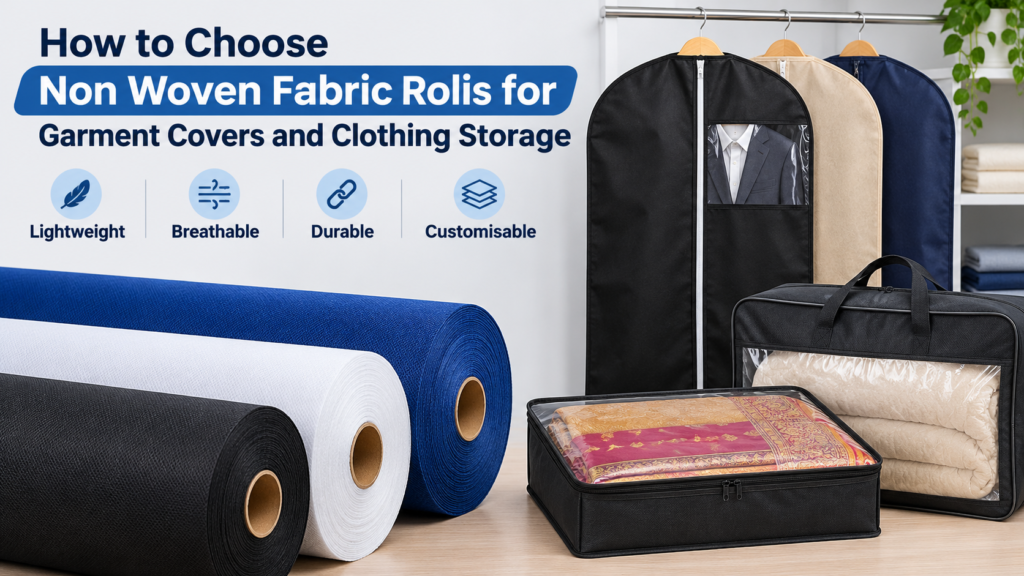
Choosing the right non woven fabric rolls for garment covers is important for manufacturers producing suit covers, saree bags, dress covers, wardrobe organisers and clothing storage products.
The fabric’s weight, strength, breathability, colour and finish can influence the appearance, functionality and durability of the finished product. Polypropylene (PP) spunbond non woven fabric is a practical option for many garment packaging and storage applications because of its lightweight construction and converting possibilities.
However, not every fabric grade is suitable for every product. Manufacturers must consider the intended use, production process and customer requirements before placing a bulk order.
This guide explains how to select suitable fabric rolls, compare material specifications and evaluate quality before manufacturing garment covers.
What Is Non Woven Fabric?
Non woven fabric is produced by bonding or mechanically interlocking fibres or filaments rather than weaving or knitting yarns.
PP spunbond non woven fabric is manufactured by forming continuous polypropylene filaments into a web and bonding them into a fabric sheet.
Manufacturers purchase fabric in rolls and convert it into finished products through cutting, stitching, printing or compatible sealing processes.
For example, a garment cover manufacturer may cut black PP spunbond fabric into panels, add a transparent window and zipper, and stitch the components together to produce a suit cover.
The appropriate fabric grade depends on the cover design and expected usage.
Types of Non Woven Fabric Rolls for Garment Covers
Different fabric finishes offer different characteristics. Selecting the appropriate material helps manufacturers balance appearance, functionality and production requirements.
| Fabric Type | Material Characteristics | Suitable Applications |
| Plain PP spunbond | Lightweight fabric with air permeability that varies by grade | Suit covers, saree bags and dust covers |
| Printed non woven fabric | Fabric carrying a printed logo, pattern or design | Branded garment covers and retail packaging |
| Laminated non woven fabric | Non woven material combined with a film layer | Selected packaging and storage products requiring additional surface protection |
| Embossed or textured fabric | Fabric with a patterned surface | Decorative garment covers and selected storage organisers |
Plain PP spunbond is a useful starting option for many garment cover designs. Printed and laminated materials may require additional processing or specialized grades.
Confirm availability, print compatibility and finish requirements with your fabric supplier before ordering.
Key Specifications of Non Woven Fabric Rolls for Garment Covers
When sourcing fabric for garment cover manufacturing, buyers should evaluate more than the price per kilogram.
The following specifications help determine whether the material is suitable for the finished product.
| Specification | What Manufacturers Should Check |
| GSM | Fabric mass per square metre and permitted variation |
| Roll width | Compatibility with cutting layouts and production machinery |
| Roll length | Required production quantity and usable material per roll |
| Colour | Consistency with approved colour samples |
| Tensile and tear strength | Ability to withstand the intended handling and loading conditions |
| Thickness | Suitability for the cover design and converting process |
| Air permeability | Required airflow for the intended storage application |
| Surface finish | Compatibility with printing, stitching or lamination |
GSM stands for grams per square metre. It measures the mass of the fabric over a specified area rather than its strength directly.
The ISO 9073-1:2023 standard describes a method for determining the mass per unit area of nonwoven materials.
Although heavier fabrics may offer greater opacity or strength in some constructions, performance also depends on filament properties, bonding and material uniformity.
Applications of Non Woven Fabric in Garment Covers and Clothing Storage
Non woven fabric rolls can be converted into various garment packaging and storage products.
1. Suit and Blazer Covers
Suit covers help reduce exposure to dust and handling during transportation and everyday storage.
Manufacturers can incorporate zippers, transparent windows, hanger openings and printed branding according to the product design.
Fabric strength around the hanger opening and zipper should be checked during sample testing.
2. Saree and Lehenga Storage Bags
Non woven fabric can be used to manufacture storage bags for sarees, lehengas and other traditional clothing.
These products help users organise garments and reduce direct exposure to dust.
For heavier or heavily embellished garments, manufacturers should evaluate the finished bag’s strength, dimensions, seam construction and suitability for the intended textile.
3. Dress and Gown Covers
Long garment covers are commonly designed for dresses, gowns and formal clothing.
Fabric width and cutting layouts are important because longer products require larger panels. Selecting appropriate roll dimensions can help reduce unnecessary material waste.
4. Blanket and Quilt Storage Bags
Blanket and quilt bags generally require larger fabric panels and seams designed for the expected contents.
Manufacturers should evaluate handle attachment, zipper strength and the ability of the finished bag to withstand repeated handling.
5. Wardrobe Organisers and Shoe Bags
Non woven fabric can also be used for storage pouches, shoe bags and selected wardrobe organiser designs.
Products carrying heavier items may require reinforcement or additional structural components.
6. Branded Retail and Tailoring Covers
Garment brands, boutiques and tailoring businesses can use customized covers as part of their packaging.
Printing, colour selection and consistent finishing can help maintain a uniform brand appearance across production batches.
Benefits and Limitations of Non Woven Fabric for Garment Covers
Selecting the right non woven fabric rolls for garment covers requires balancing material performance, production costs and customer expectations.
| Performance Factor | Benefit or Trade-off |
| Lightweight construction | Can reduce the weight of finished covers, although lighter grades may have lower strength |
| Breathability | Suitable plain grades allow airflow; laminated materials may reduce air permeability |
| GSM | Influences material weight and cost but does not determine strength alone |
| Opacity | Depends on colour, weight and fabric construction |
| Flexibility | Softer grades may suit flexible covers, while stiffer materials may suit structured products |
| Printing | Supports branding when the fabric surface and printing process are compatible |
| Durability | Depends on fabric strength, seam quality, fasteners and intended usage |
| Surface protection | Some finishes may improve resistance to splashes, but the completed cover is not necessarily waterproof |
Air permeability can be evaluated using relevant test methods, such as ISO 9073-15.
Manufacturers should avoid assuming that a particular material will prevent moisture, mould or damage under all storage conditions. The garment, finished cover design and surrounding environment also influence storage performance.
How to Choose Non Woven Fabric Rolls for Garment Covers: 5 Key Checks
Before placing a bulk fabric order, manufacturers should complete the following five checks.
1. Define the Product and Its Intended Use
Identify whether the fabric will be used for suit covers, saree bags, dress covers, storage pouches or larger bedding organisers.
Consider the expected contents, handling frequency, customer requirements and whether the finished product is intended for repeated use.
2. Select the Appropriate GSM and Strength
Choose the material weight according to the product design rather than selecting fabric based on GSM alone.
A lightweight retail delivery cover and a reusable blanket storage bag may require different material properties.
Test the fabric’s tensile strength, tear resistance and seam performance wherever these properties are important to the product.
3. Match Roll Width to Your Cutting Layout
Selecting a suitable roll width can help improve material utilization during manufacturing.
Calculate the required panel dimensions, seam allowances and cutting arrangement before confirming the order.
Discuss customized roll widths and lengths with your supplier to match the production process.
4. Choose the Colour and Surface Finish
Select colours that meet customer expectations and complement the finished cover design.
For branded products, check colour consistency, printing compatibility and the appearance of the finished sample.
When using laminated materials, assess whether reduced airflow is acceptable for the intended storage application.
5. Test Samples Before Bulk Purchasing
Request fabric samples and manufacture a small number of finished covers before approving the material for large-scale production.
Evaluate stitching, zipper attachment, hanger openings, appearance, printing and handling performance.
Confirm all agreed specifications and acceptance criteria in writing.
Quality Checks Before Accepting Fabric Rolls
Inspecting incoming material can help identify production problems before the fabric is converted into finished covers.
Manufacturers should check the following:
- GSM consistency: Measure representative samples and compare results with the agreed specification.
- Roll dimensions: Confirm usable width and length according to the purchase requirements.
- Colour consistency: Compare the material with an approved sample under consistent lighting.
- Surface quality: Inspect for holes, stains, thin areas and visible bonding defects.
- Mechanical strength: Verify required tensile, tear and seam performance using suitable testing methods.
- Print quality: Where applicable, inspect colour registration, clarity and ink adhesion.
- Batch identification: Maintain records of supplier details, production batches and inspection results.
A manual pull check may help identify obvious defects, but it should not replace documented mechanical testing where measurable strength requirements apply.
For larger orders, agree on a sampling and inspection procedure with the supplier.
Storage and Handling of Non Woven Fabric Rolls
Proper storage helps maintain the condition of fabric before manufacturing.
Keep rolls in a clean, dry environment away from direct sunlight and excessive heat. Retain protective packaging until the material is required and follow the supplier’s recommendations for stacking and handling.
Maintain batch labels and use an appropriate stock rotation system to avoid mixing unapproved material grades.
Finished garment covers should be used according to the clothing manufacturer’s care instructions. Clothing should be clean and fully dry before storage.
For delicate, valuable or heavily decorated garments, specialized storage materials and methods may be necessary. The Canadian Conservation Institute’s textile care guidance provides additional information about appropriate textile storage conditions.
Common Mistakes to Avoid When Buying Non Woven Fabric Rolls
Manufacturers should avoid the following material selection and purchasing mistakes:
- Choosing fabric based only on the lowest purchase price.
- Assuming that higher GSM always guarantees better strength.
- Ignoring roll width and cutting efficiency.
- Selecting laminated materials without considering ventilation requirements.
- Using fabric without testing the finished cover’s seams and fasteners.
- Approving printed material without checking print compatibility.
- Ignoring colour variation between production batches.
- Purchasing large quantities without written specifications or sample approval.
Avoiding these mistakes can help manufacturers reduce material rejection, unnecessary waste and production difficulties.
PP Spunbond Non Woven Fabric Rolls from Metro Plasto
Metro Plasto is a non woven fabric manufacturer in India, based in Bhiwani, Haryana.
The company manufactures and supplies PP spunbond non woven fabric rolls with customizable material specifications for various industrial and packaging applications.
Available customization options include fabric GSM, colours, roll widths and roll lengths, subject to order requirements and availability.
Manufacturers sourcing material for garment covers, storage bags and related packaging products can discuss their required specifications with Metro Plasto.
Businesses producing other packaging products can also explore our non woven fabric for bag manufacturing.
For additional information about fabric construction and manufacturing, read our guide to PP spunbond non woven fabric manufacturing.
Before requesting a quotation, prepare details about your product design, required material grade, GSM, colour, roll dimensions and order quantity.
Frequently Asked Questions (FAQs)
Why is non woven fabric used for garment covers?
Suitable non woven fabrics offer lightweight construction, customization options and compatibility with various converting processes. They can be used to manufacture covers that help reduce exposure to dust and handling.
What GSM is best for garment covers?
There is no universal GSM suitable for every garment cover. The appropriate fabric weight depends on the product design, required strength, expected usage and production process. Manufacturers should approve samples before bulk purchasing.
Is PP spunbond non woven fabric breathable?
Many plain PP spunbond fabrics allow air to pass through their structure. Actual air permeability depends on fabric construction, bonding, weight and surface treatments.
What is the difference between plain and laminated non woven fabric?
Plain non woven fabric does not have an additional laminated film layer. Laminated fabric combines the nonwoven structure with another material, which may change its surface protection, stiffness and air permeability.
Can non woven fabric be used for saree and clothing storage bags?
Suitable grades can be converted into saree bags and clothing organisers. The finished product should be designed according to garment weight, handling requirements and intended storage conditions.
Can I order customized non woven fabric rolls from Metro Plasto?
Metro Plasto offers customization options for GSM, colour, roll width and roll length. Contact the team to discuss available grades, quantities and specific application requirements.
Conclusion
Selecting the right non woven fabric rolls for garment covers involves evaluating fabric weight, strength, dimensions, air permeability, surface finish and manufacturing compatibility.
Manufacturers should approve samples, check the performance of finished products and confirm material specifications before placing bulk orders.
Metro Plasto supplies PP spunbond non woven fabric rolls for various industrial and packaging applications.
Looking for fabric rolls for garment covers or clothing storage products? Contact Metro Plasto to discuss your material requirements and request a quotation.