
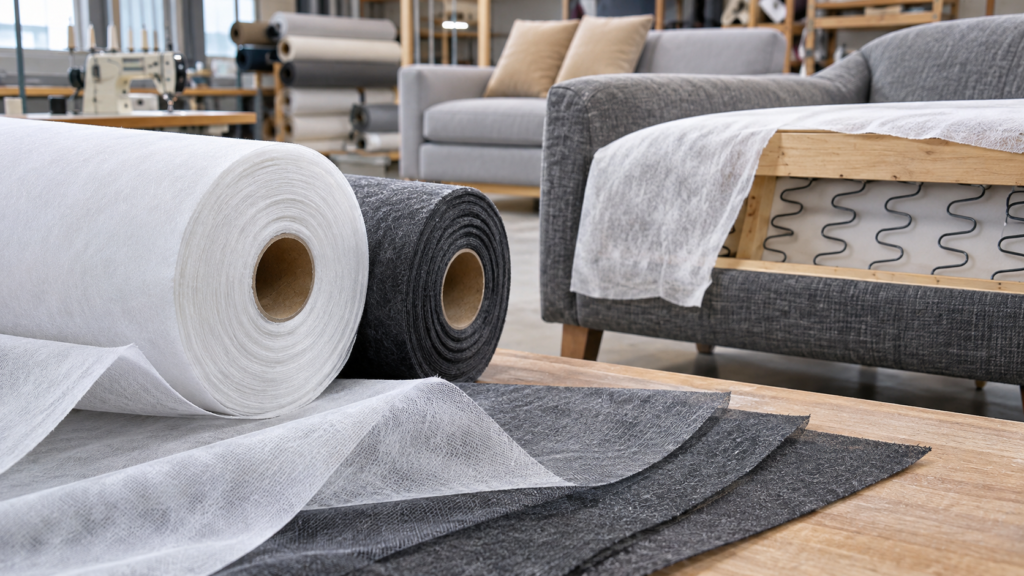
A glance under your couch, inside a mattress, or on the back of a chair will often reveal a layer of light, paper like material that serves an important function. This is nonwoven fabric. This article is intended for furniture makers, mattress producers, people who do upholstery, and fabric buyers to help them understand nonwoven.
Quick answer: The most common nonwoven fabric for furniture upholstery uses includes dust covers placed under couches and beds, pocket spring covers in the mattress, interlining and curtain linings, quilting backing, covers for cushions and pillows, and beds for furniture and its protection in packaging. The most popular nonwoven type is PP spunbond nonwoven, as it is light, breathable, easy to cut and sew, and cheap. However, the right option will depend on GSM, width, colour, strength, and any needed finishes.
What Is NonWoven Fabric?
Nonwoven fabric is made of bonded fibres united through heat, pressure, and other techniques. In terms of furniture, the most common type is polypropylene (PP) spunbond, which is made from continuous strands of polypropylene fused together through processes involving heat.
With upholstery, nonwoven fabric can hardly be seen since it serves a functional role rather than a decorative function. It supports, separates, lines and protects the parts of a sofa, bed or mattress.
Types, Structures and Key Specifications
| Type | Key features | Typical furniture use |
| PP spunbond | Light, strong for its weight, breathable | Dust covers, spring pockets, linings, inner covers |
| Needle-punched | Thick, dense and felt-like | Insulator pads, padding layers |
| Thermal-bonded / wadding | Soft and lofty | Quilting and cushioning layers |
| Laminated or coated | Smoother, more water-resistant | Protective covers and packaging |
Specifications to check:
- GSM: The weight of the fabric, which influences thickness and strength
- Width and length of the roll: Required to fit your cutting patterns and minimise wastage
- Colour: Black and white are generally used for dust covers; other colours may work for visible linings.
- Tensile strength: Vital for spring pockets and stretch linings
- Finishes: Such as flame-retardant and antibacterial treatments that are required for your product/market
- Raw material: 100% virgin PP or a mix with fillers
How NonWoven Fabric Is Used in Furniture and Upholstery
These are most common fabric applications in furniture and bedding:
- Dust cover: It is a type of material that is stapled at the bottom of sofas, chairs, and beds.
- Pocket spring cover: Each of the springs of a pocket spring mattress has its own covering.
- Spring insulator: It is used to protect padding from damage.
- Lining and interlining: They are placed under the main fabric of the sofas and chairs to make them look more appealing.
- Quilting backing: It is used as the first layer of quilted mattress panels and upholstery as well.
- Pillow and cushion cover: It is designed to keep the foam or fibre filling inside the pillow/cushion.
- Deck and back covers: These two types of fabric are used for hidden parts of seats and backs.
- Protective wrapping: New furniture should be wrapped very carefully to avoid any damage when moved from one place to another. See our nonwoven fabric for packaging.
Performance Factors and Trade-offs
Benefits:
- Light: That means minimal weight has been added to the weight of the product.
- Permeable: The fabric allows air to pass through the cushions and mattresses.
- Easy to process: The fabric can be cut stained and sewn very easily.
- Readily available in supply: Available in large rolls and in many different widths and colours.
- Inexpensive: one of the cheaper fabrics for hidden upholstery layers.
Trade-offs:
- Not a beauty fabric: Most of the nonwovens are not meant to be used in high-wear surfaces.
- Durability: The lighter weight versions can wear off easily.
- Flammability: Standard polymer polypropylene fabrics are flammable. If your market or customer requires flame resistance, choose a suitably treated grade and confirm the test results.
- Easy to damage: The material can be damaged when exposed to sunlight for a long period of time.
Performance factors include GSM of the fabric, material quality, and finishing techniques.
How to Select the Right Material and Supplier
Material selection is driven by the end-use of the fabric:
- Define the end use: Dust covers, spring pockets, linings, quilts, or packaging.
- Choose the GSM: The lighter grades are suitable for dust covers and linings, while stronger grades are used for spring pockets and other stress points. Confirm suitable GSM ranges with your supplier and by testing.
- Select the width and/or colour of the fabric. This will depend on the cutting pattern.
- Decide on finishes: Only add flame-retardant, antibacterial, or other treatments if they are necessary for the product or market.
- Request samples: Get samples for cutting or stapling, sewing or ultrasonic sealing; whatever is applicable for your production process.
Example: A mattress manufacturer would use a heavier spunbond fabric for its pocketed springs and a lighter fabric for the quilt background; in contrast, a sofa manufacturer may use black spunbond fabric for dust covers.
When selecting suppliers, check the following:
- Specification clarity for GSM, width, colour and roll length
- Raw material quality should be as high as possible (ideally 100% virgin polypropylene).
- Quality consistency across repeated orders
- Sample and test data
- Minimum order quantity (MOQ), production capacity and delivery schedules
Quality Checks and Handling
- Verify GSM: Weigh a sample of the fabric to confirm the claimed GSM value.
- Look for uniformity: Hold the fabric to the light to examine it for any thinner sections and holes.
- Test the strength: Manually pull at fabric samples or request the tensile test reports of the fabric for spring pockets.
- Inspect the rolls: Check for consistency in winding, clean edges, and correct width.
- Store properly: Keep the rolls dry and the fabric clean and shield it from direct sunlight and high temperatures.
Common Mistakes to Avoid
- Choosing the lowest GSM to save cost: This material may rupture in areas that are under a lot of pressure, like spring pockets.
- Using nonwoven as a visible face fabric: The majority of types of this fabric are not made to handle heavy use in visible areas.
- Ignoring flame-safety requirements: We’ll need to determine what the customers in your market want or need.
- Skipping production trials: Some fabrics may look good, but they may not cut or sew effectively on your equipment.
- Relying on verbal specs: Be sure to request GSM, width, finish, and material specifications on every order.
Frequently Asked Questions
What should I know first about nonwoven fabric for furniture?
Typically, nonwoven fabric serves as a concealed layer, which one uses normally as a dust barrier, spring pocket, lining, or inner covering, rather than the visible upholstery textile.
How do I choose the right nonwoven fabric for upholstery?
Select the appropriate type of fabric with the right GSM, choose suitable width and color for your production, add finishes only where necessary, and perform your own tests.
Which specifications or quality checks matter most?
GSM, width, colour, tensile strength, raw material quality, any required finishes such as flame resistance, and consistency across rolls.
How should nonwoven fabric be stored and handled?
Nonwoven fabric has to be stored in a dry and clean area, avoiding direct sun rays or heating; rolls should stay wrapped until they are used.
Conclusion
Nonwoven fabric for furniture upholstery uses ranges from dust covers and spring pockets to linings, quilting backing, and protective packaging. It is essential to pick up the suitable type and GSM of nonwoven fabric for each particular purpose and check the fabric’s quality and finishing before placing a large order with a supplier who provides a reliable product and precise technical specifications.
Metro Plasto has been producing PP spunbond nonwoven fabric in Haryana since 2011. The fabric is made using 100 percent virgin polypropylene and comes in various shades for such applications as furniture, bedding, packing, etc. Contact Metro Plasto for samples and a quick quote.