
When it comes to selecting a diaper raw material supplier in India, it is vital for companies involved in manufacturing hygiene products seeking quality consistency, competitive pricing, and dependable bulk supply. As far as the disposable diapers are concerned, they include nonwoven materials, superabsorbent polymers (SAPs), fluff pulp, elastic bands, adhesives, and fasteners. The specific purpose of these materials is to ensure absorbency, comfort, good fit, leak-proofness, and performance of the product. This is why the decision about which supplier to choose must be made based on the material quality, as well as criteria like material specifications, testing methods, certifications, customisation, production capacity, and delivery reliability.
What Raw Materials Are Used in Disposable Diapers?
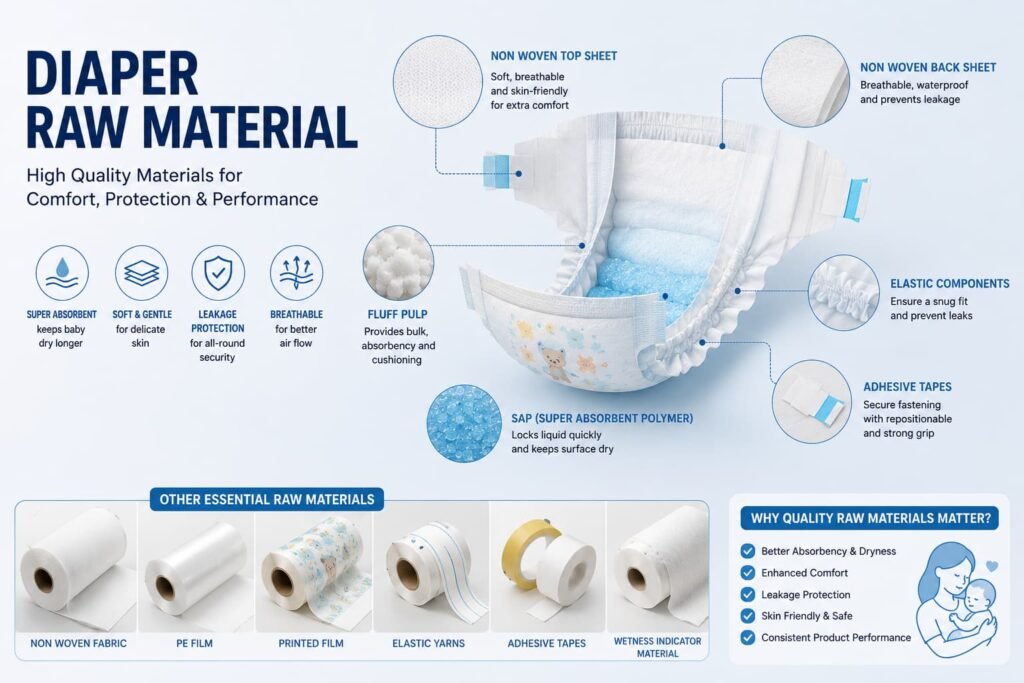
A disposable diaper is a product that is made of multiple layers of material, and every layer has a defined function. Usually it is made of the following:
| Raw Material | Function | Typical Application |
Top Sheet | Provides a soft, skin-friendly surface and allows fluid passage | Inner layer of diaper |
ADL | Distributes fluid evenly within the absorbent core | Acquisition and distribution layer |
SAP | Absorbs and retains a great amount of fluid | Absorbent core |
Fluff Pulp | Distributes fluid evenly and absorbs it | Absorbent core |
Backsheet | Helps prevent liquid leakage | Outer layer |
Elastic | Provides stretch and a secure fit | Leg cuffs and waist |
Frontal Tape | Enables adjustable fastening | Diaper closure system |
Hot Melt Adhesive | Bonds different diaper components | Core and structural assembly |
A reliable diaper raw material manufacturer can help manufacturers choose raw materials based on the design of the nappy, the intended target market, absorbency and the production process.
How Diaper Raw Materials Are Manufactured
Raw material for diaper production can be made by a number of different methods depending on the material used. SAP is produced using absorbent polymers designed to absorb liquid and swell. Nonwoven materials can be made by the spunbond method or by other web-forming technologies.
Fluff pulp, on the other hand, is processed from cellulose, while elastic materials are formed from elastic polymers, and hot-melt adhesives are used to bond diapers at extremely fast production speeds.
Types of Diaper Raw Materials and Their Applications
Various parts of the diaper meet various performance requirements:
- Topsheet nonwoven: Provides softness, comfort, breathability, and quick passage of liquid.
- Acquisition distribution layer (ADL): Allows the movement of liquid from the site of acquisition and its distribution in the absorbent core.
- Superabsorbent polymer (SAP): Gives the ability to absorb and retain large amounts of water.
- Fluff pulp: Helps in spreading the liquid and forming the absorbent structure.
- Backsheet: Provides protection from leaking and may be made of breathable or laminated materials.
- Elastics: Provide stretch and fit at the waist and around the legs.
- Frontal tape: Joins with fastening systems to provide adjustability for diaper closure.
- Hot melt adhesive: Joins different layers and components at high speed.
How to Choose the Best Diaper Raw Material Supplier in india
Before going for bulk ordering, manufacturers have to keep two factors in mind about their suppliers: the efficiency of materials and reliability of supply. Think about a few things like production capacity, raw materials needed, quality control, customisation options and delivery times.
Supplier Evaluation Checklist
- Quality of raw materials and their specifications
- Production capacity and scalability
- Consistent quality of batches
- Relevant certifications and test reports
- customization capabilities
- Minimum order quantities and price structure
- Time of production and delivery
- Packaging and storage requirements
- Technical support
- Ability to fulfill recurring bulk orders
Quality Testing Every Buyer Should Verify
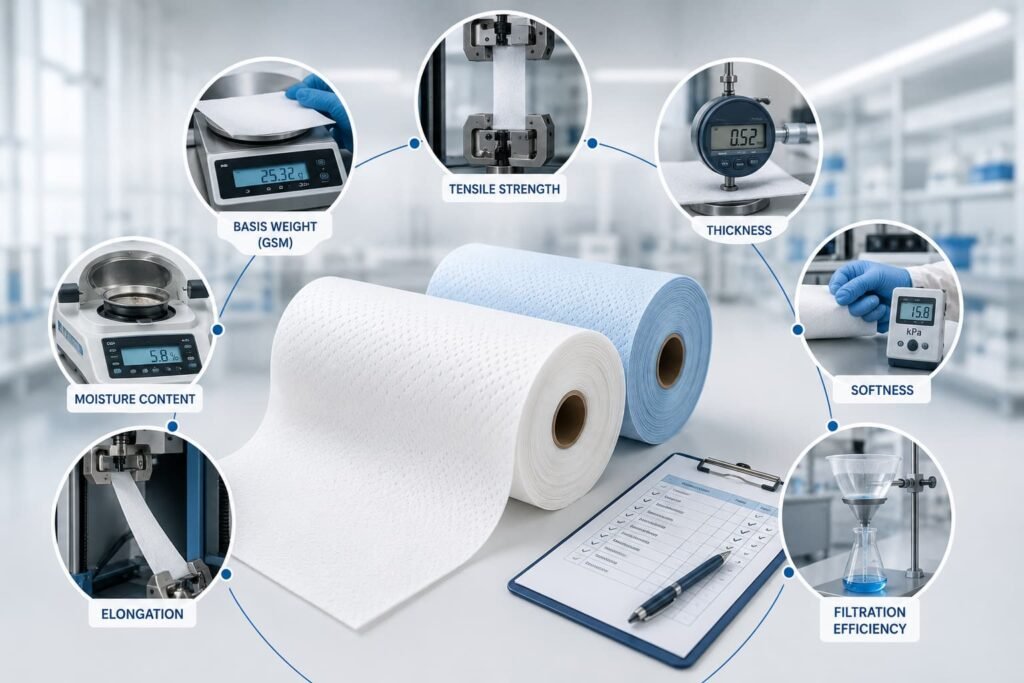
Manufacturers need to assess performance parameters specific to materials before buying bulk diaper raw material in india. The tests involved may vary according to the type of material. They include the following parameters as well:
- GSM and thickness
- Tensile strength and tear strength
- Absorption and retention capacity
- Liquid distribution and acquisition
- Elasticity and recovery.
- Adhesive strength
- Moisture and dimensional stability
- Uniformity between various batches.
It is important that the test requirements align with the performance expected from the finished diapers and the applicable standards.
Certifications and Compliance Standards
Various certification requirements are based on either the type of raw materials used and products manufactured or the market and intended use of a product. A buyer must obtain the confirmed certificate of quality, technical data sheet, test reports, and certificates of compliance from their suppliers.
For products manufactured for sensitive skin or products concerned with hygiene standards, it is important that a manufacturer verify applicable safety and material requirements before approving a supplier.
Bulk Procurement Process: From Inquiry to Delivery
A detailed procurement process produces fewer quality problems as well as shipping delays.
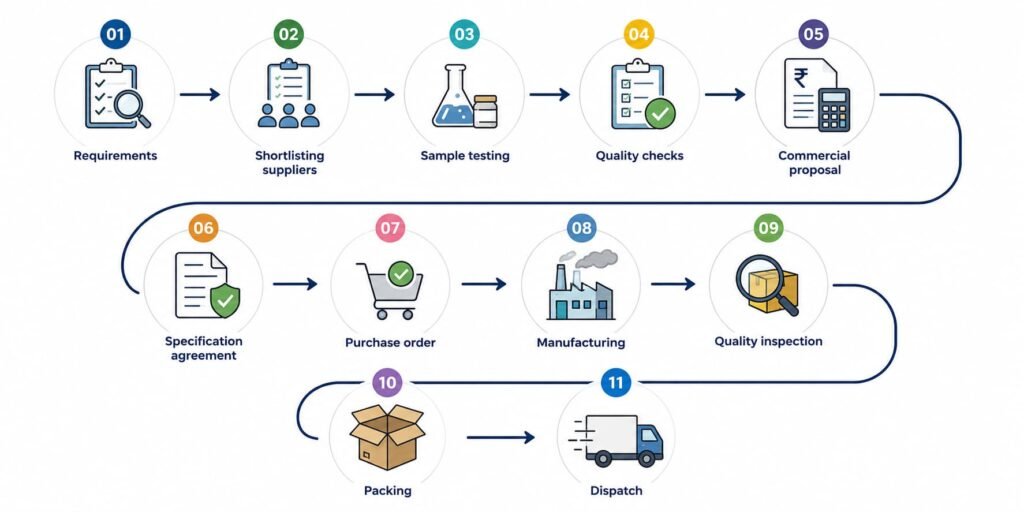
Before confirming an order, clarify the specifications of the material, quantity, MOQ, price, terms of payment, packing rules, and deadlines.
In case of repeated orders, it is appropriate to have a specification sheet approved in advance.
Sustainable Manufacturing Practices
The importance of sustainability is growing for producers of hygiene products. Buyers can assess suppliers according to different criteria, including the efficiency of materials, management of production wastes, responsible sourcing, recyclability of packages, energy efficiency, and availability of sustainable material alternatives.
Producers should ask suppliers to provide proof of sustainability efforts instead of being satisfied with general statements.
Common Buying Mistakes to Avoid
- Selecting solely based on cost: Cheap prices might imply trade-offs on quality or consistency.
- Skipping sample testing: Evaluate GSM, strength, thickness, finish, and suitability for the application before full-scale production.
- Overlooking specifications: Make sure to specify materials, GSM, width, colour, roll length, and purpose.
- Not checking production capacity: Be sure that the manufacturer can deliver the needed current and future volumes.
- Ignoring certifications: Make sure to check the relevant certifications and testing documentation.
- Ignoring lead times: Clarify the order quantities and delivery schedules in advance.
- Failing to discuss customisation: Make sure to communicate specific requirements regarding material properties before production.
Conclusion
Choosing the reliable diaper raw material supplier in India can assist manufacturers of hygiene products in securing steady product quality and a smooth production process, as well as a dependable supply chain. The right supplier offers all kinds of raw materials, from topsheets and ADL to SAP, fluff pulp, elastics, and adhesives.
A reliable diaper raw material manufacturer could become a loyal partner by ensuring stable quality and flexible supply chain management.
Read also: Packaging Material Manufacturer: Complete Guide
Frequently Asked Questions
What raw materials are used in disposable diapers?
Raw materials used include the topsheet, ADL, SAP, fluff pulp, backsheet, elastic, frontal tape, and hot melt adhesive.
Which nonwoven fabric is best for diaper topsheets?
Diaper topsheets are manufactured using soft spunbond nonwoven fabric having suitable liquid pass through, strength, and breathability properties.
What is ADL in diaper manufacturing?
ADL means acquisition and distribution layer and is responsible for fast acquisition and distribution of the fluid.
What is SAP, and why is it important?
ADL stands for Acquisition and Distribution Layer and absorbs the liquid and retains it. So, it forms a major part of the diaper absorbent core.
How do I choose a diaper raw material supplier in India?
You must take into account the quality of raw materials, testing and relevant certifications, production capacity, possibility of customisation, pricing, minimum order quantity, lead time, and bulk supply capability.
What certifications should a supplier have?
The requirement of certificates depends on the kind of material and application. You need to ask the supplier for the appropriate quality certificates, test reports, technical documentation, and necessary compliance.