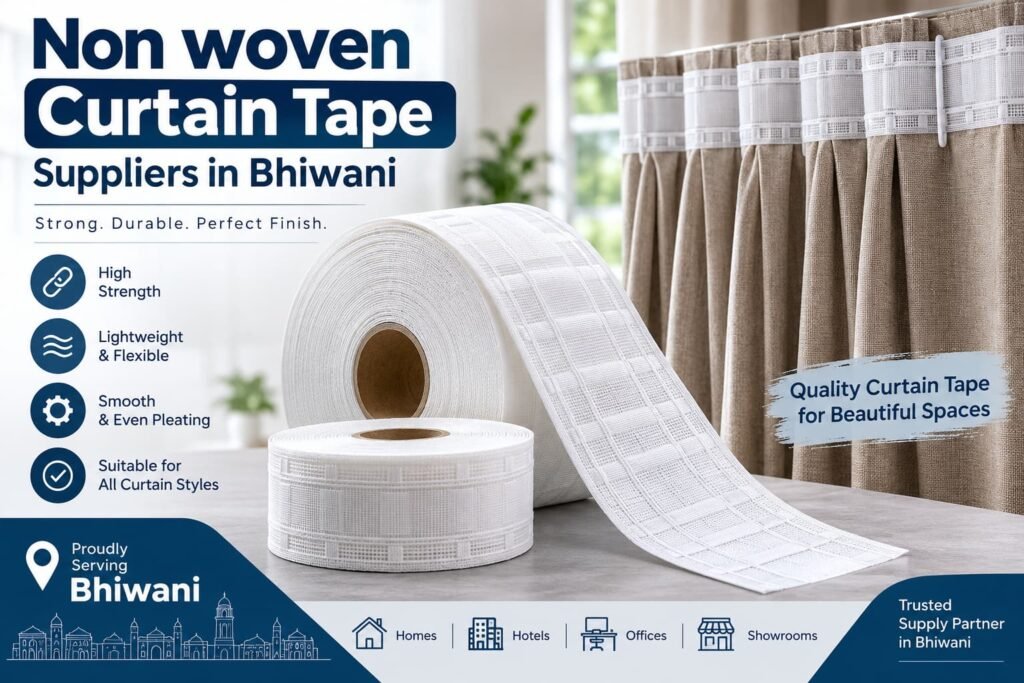
Purchasing from reputed Non woven Curtain Tape Suppliers in Bhiwani gives bulk suppliers a huge head start in this market, as this area has become a prominent manufacturing centre for nonwoven materials and has enough infrastructure and company networks to ensure regular bulk shipments. For curtain header tape, the supplier must be checked for material strength and stitching characteristics, which makes choosing the right supplier more important than it may seem at first glance. A header tape that appears to be decent but is not strong enough after multiple washes or fails at stitching when operated normally will cause unexpected expenditures for curtain producers. This guide covers the fabric types used specifically for header tape, the quality checks that actually matter, and how bulk procurement works with a curtain tape nonwoven fabric manufacturer based in Bhiwani.
Why Bhiwani Is a Preferred Manufacturing Hub
Non woven Curtain Tape Suppliers in Bhiwani has turned into a centralised region for nonwoven fabric manufacturing, allowing customers to purchase from more than one established manufacturer in the region rather than having to deal with many suppliers from different unverified zones. Thus, the region provides a number of advantages for buyers making bulk purchases. As an example, distance between a manufacturer and a raw material supplier shortens lead times, makes it easier for an important buyer to visit suppliers’ factories or perform audits, and lowers price levels thanks to a significant number of manufacturers working in the region. For buyers interested in the chance to evaluate facilities in person or create lasting partnerships with their suppliers, the presence of many choices in the same industrial area decreases the sourcing risks, especially in terms of working with a distant unknown supplier.
Types of Non woven Fabrics Used for Curtain Tape
Usually, curtain header tape is made from PP nonwoven fabric instead of the woven variants because of the fact that nonwoven construction provides better shape retention and stiffness in the process of repeated sewing and hook insertion.
| Type | GSM Range | Key Property | Best Use |
| PP Spunbond (Standard) | 60 to 90 GSM | Balanced stiffness and cost | General curtain header tape |
| PP Spunbond (Reinforced) | 90 to 120 GSM | Higher stiffness, stronger stitch retention | Heavy curtains, pleated headers |
| Laminated Non-Woven | 100 to 140 GSM | Water-resistant, glossy finish | Premium or branded curtain tape |
For most standard curtain tape manufacturing, 80 to 100 GSM offers the right balance of stiffness for pleat retention without adding unnecessary material cost.
Key Quality Parameters Buyers Should Verify
Before making bulk purchases, buyers need to ascertain that the supplier undertakes these tests, preferably with actual reports rather than just general reassurance:
- GSM consistency throughout the entire roll, as the difference between the start and the end of the roll is a common quality problem that materialises once the fabric is put into production.
- Tensile strength of the header tape as it undergoes mechanical stress due to hooks and compaction machines and changes hands many times when assembling the curtains.
- Stitch-hold strength, which means how successfully the fabric keeps its stitching from being torn or frayed, making it arguably the most significant indicator of header tape.
- Colourfastness is particularly relevant for tape used in visible or branded curtain applications where fading would affect the finished product’s appearance.
In case a buyer is dealing with a new supplier, it is advisable to perform physical tests on the stitch hold strength.
Applications of Curtain Tape Nonwoven Fabric
- Pleated curtain headers: pencil pleat, pinch pleat, and box pleat curtains
- Home furnishing manufacturers: bulk tape for curtain production lines
- Hospitality and hotel furnishings: large-volume curtain manufacturing
- Export-orientated textile units: supplying finished curtains to international markets
How to Choose the Right Curtain Tape Nonwoven Fabric Supplier
Supplier Evaluation Checklist
- Production capacity for the repeated fulfilment of bulk orders
- GSM and stiffness customisation options
- Sample availability can be provided before the order is placed.
- Batch consistency of production in all the batches
- Export documentation support for international clients
- Transparent, volume based pricing; costs typically scale with GSM, order volume, and any lamination or finishing requirement.
Manufacturing Process
Curtain tapes are produced by following certain techniques associated with the nonwoven production process: polypropylene resin sticks, after having been melted and extruded into long fibres, are laid out in a random manner on a conveyor belt and then bonded through the application of heat and pressure to obtain one strip of cloth without any knitting or weaving involved in production. Manufacturers must control header tape bonding much more precisely than standard packaging-grade fabric, as variations in fabric tension directly impact performance during sewing and pleating. If the bond is too weak, the tape may pass initial strength tests but still tear during high speed production. Consequently, buyers sourcing fabrics for automated curtain production lines must ask suppliers about their specific header tape bonding procedures, even when purchasing nonwoven options.
Bulk Procurement Process
Sourcing bulk curtain tape fabric generally follows a five-step process:
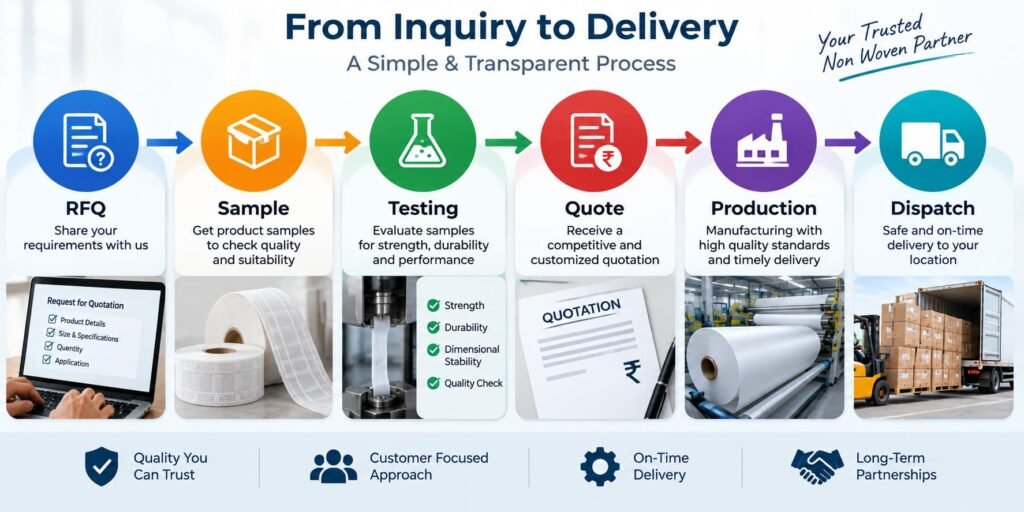
The procedure starts with an RFQ, wherein the buyer informs the GSM, stiffness requirements, and order size. Thereafter, the supplier sends a sample, which is to be tested by the buyer for stitch hold strength and pleat retention independently, prior to ordering and shipping. This is particularly important for header tape compared with ordinary fabric since the performance problems appear only when the fabric has been stitched into something. After confirming specifications, a formal quote is generated, and production starts with shipment to the buyer’s address. Buyers working with a new supplier for the first time should treat the sample and testing stages as non-negotiable, regardless of how competitive the initial quote appears. something going wrong.
Packaging, Storage & Logistics
Curtain tape fabric rolls are typically wrapped in protective plastic and stacked on pallets for bulk shipment. Storage conditions should be regulated in a way that the moisture is not present and sunlight is not directly contacting it. Since UV exposure can weaken polypropylene fibres and affect stiffness over time, it is a particular concern for header tape, where consistent rigidity matters more than in general packaging fabric.
Expert Tips for Curtain Tape Buyers
- You should get a piece of a sample to check the strength of the stitching before buying the bulk amount of the product.
- Match GSM to your curtain weight; heavier curtains need reinforced, higher-GSM tape
- Contact the supplier you have been using regularly to make sure that the batch you are about to buy is the same and has the same GSM as well.
- Lamination is important to consider in case you are producing high-end curtains.
Conclusion
Finding reliable curtain tape and nonwoven fabric suppliers in Bhiwani is simply a matter of matching the required GSM and stiffness with the type of curtains needed, checking the stitch hold ability before ordering in bulk, and ensuring that your manufacturer will be able to provide you with consistent repeat order batches. With so many well established suppliers in Bhiwani, it is a natural choice for domestic and export focused curtain manufacturers.
Frequently Asked Questions
What is curtain tape nonwoven fabric?
Nonwoven PP fabric is manufactured to dimensions with the required strength and stitch-hold properties, which make it suitable for curtain header tape.
Which GSM is best for curtain tape manufacturing?
GSM of 80 to 100 has been determined to be ideal due to optimal strength and cost parameters, while GSM of 90 to120 tends to be used for larger, more robust, reinforced headed pleats.
Why is nonwoven fabric used in curtain header tapes?
Nonwoven fabric maintains its shape and thickness much better than woven alternatives while being subjected to stitching and installation of the hooks.
What quality tests should buyers check?
Buyers should check GSM consistency, tensile strength, stitch holding strength, and colour fastness prior to placing the bulk order.
Do Bhiwani suppliers support exports?
Several Bhiwani fabric manufacturers assist their clients with export documentation, though the services do vary between companies and should be verified appropriately.
How do I choose a reliable curtain tape nonwoven fabric supplier?
Consumers should analyse suppliers in terms of production capacity, GSM customisation options, samples for testing, batch consistency, and price openness.