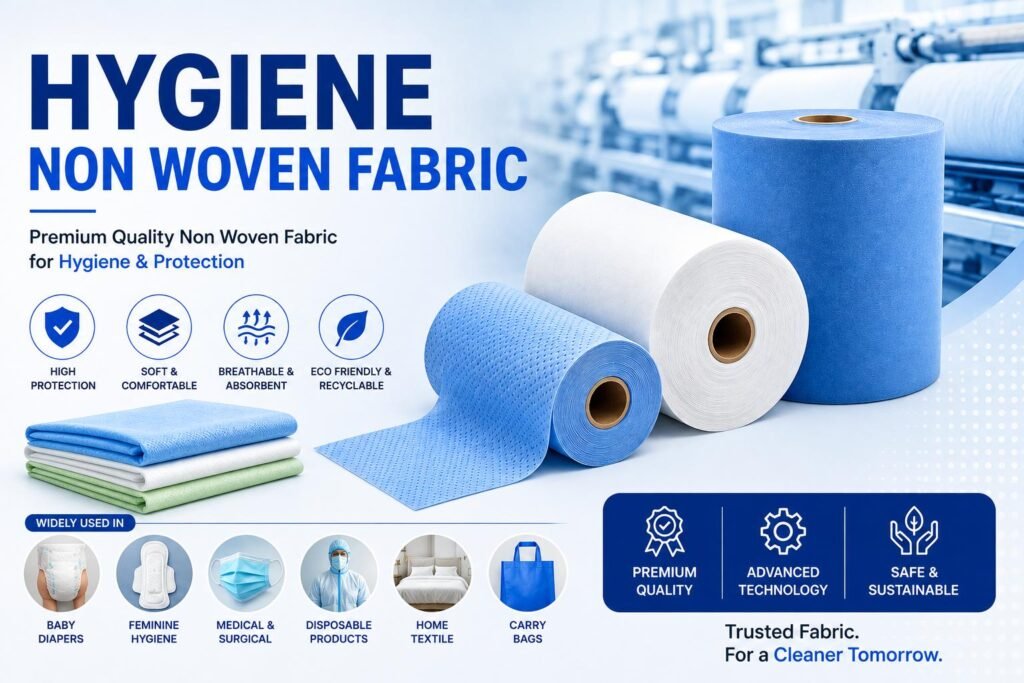
The rise in public consciousness regarding health, cleanliness, and personal care. has led to an increasing demand for high quality hygiene products. Products like nappies for babies, sanitary pads, products for adults suffering from incontinence, and wipes, as well as medical disposables, are all made from advanced materials that ensure safety, comfort, and high performance. One such material is hygiene nonwoven fabric.
A reputed hygiene nonwoven fabric manufacturer produces soft, breathable, light, and skin friendly fabrics adhering to stringent hygiene and quality standards. Whether you’re manufacturing personal care products or medical disposables, partnering with a reliable hygiene non woven fabric supplier ensures consistent quality, bulk availability, and customised solutions. This article discusses the types, applications, benefits, and factors to keep in mind while selecting hygienic nonwoven fabric.
What Is Hygiene Non Woven Fabric?
Hygiene non woven fabric is a type of fabric that has been specially made through a process of bonding polypropylene or other synthetic fibres, often without weaving or knitting them. This type of fabric is known for providing optimal softness, breathability, and liquid management as well as strength while still being lightweight and very comfortable.
Such fabrics are widely used as top sheets, back sheets, acquisition layers, and barrier layers in hygiene products. Advanced production technologies eliminate issues related to uniformity and provide excellent filtration and durability properties while being safe for the skin.
Types of Hygiene Non Woven Fabric
There are various fabric characteristics that different hygiene products ask for. A qualified hygiene non woven fabric manufacturer provides various fabric types for different applications.
Spunbond Non woven Fabric
Spunbond nonwoven fabric is known for its strength, durability, and breathability. It provides a smooth surface and offers good tensile strength as well.
Most typical applications include:
- Baby diapers
- Adult diapers
- Sanitary napkins
- Surgical gowns
- Disposable bedding
SMS Non woven Fabric
Spunbond nonwoven fabric is known for its strength, with superior filtration and liquid barrier functions. It is mainly used in medical and surgical applications.
Typical usages consist of the followin:
- Surgical gowns
- Face masks
- Surgical sheets
- Protective wear
- Sterile medical products and equipment
SS Non woven Fabric
SS (Spunbond-Spunbond) cloth has two spunbond layers that help provide comfort and flexibility. It is commonly used where skin contact is frequent.
Applications include:
- Diaper top sheets
- Sanitary pads
- Wet tissues
- Personal hygiene products
Hydrophilic Non woven Fabric
Hydrophilic fabric quickly soaks and distributes moisture, making it ideal for products that require rapid moisture management.
Applications include:
- Diaper products
- Feminine hygiene products
- Adult incontinence products
- Absorbent medical products
Hydrophobic Non woven Fabric
Hydrophobic fabric is resistant to moisture and is a strong barrier against liquid.
It is commonly used for:
- Diaper bags
- Protective medical clothing
- Surgical drapes
- Disposable covering products
Ultra-Soft Non Woven Fabric
Ultra soft non woven fabric is created with the idea of providing the highest level of comfort for people with sensitive skin. Thanks to its smooth texture, there is little irritation, making it perfect for high quality hygiene products.
Common uses include:
- Premium baby diapers
- Sanitary pads
- Facial tissue wipes
- Cosmetic pads
Applications of Hygiene Non Woven Fabric
Hygiene non woven textiles find application in the sectors of personal care and healthcare.
Some main examples of their usage:
- Diapers
- Sanitary pads
- Panty shields
- Products to curb incontinence
- Disposable, wet cloths
- Medical masks
- Surgical gowns
- Surgical covers
- Surgical linens
- Medical caps and shoe covers
- Beauty cleansers
- Beauty products
Manufacturers mostly modify the fabric properties, including softness, absorbency, size, colour, and GSM, according to product specifications.
Why Hygiene Non Woven Fabric Is Preferred
Non woven fabric used for hygiene purposes is popular because of its superior performance and good comfort and safety level.
The benefits of this material include:
- Soft and skin friendly texture
- Lightweight construction
- Excellent breathability
- Efficient liquid management
- High strength
- Minimal lint generation
- Comfortable for wearing
- Hygienic and disposable
- Cost effective production
- Suitable for automated production
- Available in multiple GSM options
These characteristics help manufacturers produce reliable hygiene products that meet consumer expectations for comfort and performance.
Key Properties to Look for Before Buying
It is essential to take into account different performance features to pick the right hygienic nonwoven fabric.
Consider getting a fabric with the following:
- Superior softness
- Consistency in GSM
- High tensile strength
- Excellent absorbency or liquid repellency (depending on application)
- Consistency in thickness
- Compatibility with skin
- Good airflow
- Low fiber shedding
- Chemical resistance
- High quality surface appearance
Choosing the right fabric guarantees enhanced performance of the products and higher satisfaction for the end-users.
Quality Standards Followed by Reliable Manufacturers
A trustworthy hygiene non woven fabric manufacturer employs various quality management systems to guarantee safety in its end products.
Quality processes are generally comprised of:
- ISO certified quality management systems
- An inspection of raw materials
- GSM consistency testing
- tensile strength testing
- Softness assessment
- Tests for absorbency and penetration of water
- Clean production areas
- Batch traceability
- Continuous quality monitoring
In addition, manufacturers utilise modern technology to ensure that the fabric has consistent fabric quality everytime regardless of the production volume.
Why Buy Directly from a Hygiene Non Woven Fabric Manufacturer?
Buying from a hygiene non woven fabric manufacturer delivers a variety of commercial and operational advantages.
Some of these are:
- Affordability of factory prices
- Bulk manufacturing capability
- Consistent quality of the product
- Custom fabric specifications
- Reliable supply chain
- Faster production
- Technical assistance
- Flexible order quantities
- Strict system of quality assurance
- Development of long term partnerships
Working directly with the manufacturer also makes communication easier and allows for quick solutions to arising problems as well as better product customisation.
Conclusion
Contemporary hygiene and medical products primarily rely on the usage of Hygiene Non Woven Fabric, thanks to its softness, durability, and breathability. It has myriad applications that need comfort and safety, from baby diapers and sanitary pads to surgical gowns and medical masks.
A reputable and competent Hygiene Non Woven Fabric Manufacturer can ensure that only the finest quality material is used, which is crucial for making effective hygiene products. The advanced manufacturing techniques and strict quality checks are of utmost importance to ensure that the business reaches various industry objectives successfully.|
Read also:
FAQs
What is hygiene non woven fabric used for?
Hygiene non woven fabric is used to manufacture baby diapers, sanitary pads, adult incontinence items, wet wipes, surgical dressings, face masks, medical curtains, etc.
Which nonwoven fabric is best for baby diapers?Which nonwoven fabric is best for baby diapers?
The types that are preferred for making baby diapers are hydrophilic spunbond, SS nonwoven fabric, and ultra-soft nonwoven fabric owing to their great softness, breathability, and ability to manage moisture.
What GSM is suitable for hygiene products?
The GSM of non woven fabrics used in most of the hygienic products varies between 10 GSM and 35 GSM as per the need for softness, strength, and absorbency.
Is hygienic non woven fabric safe for sensitive skin?
Yes. Good hygiene non woven fabrics are made with the features of being breathable and soft on skin, thus being perfect for being in contact with sensitive skin for a long time.
Can hygienic non woven fabric be customised?
Absolutely. Hygiene nonwoven fabric can be customised by manufacturers through variations in GSM, dimensions, colour, softness, hydrophilic/hydrophobic treatment, embossing, and other relevant product needs.
What is the difference between SMS and spunbond fabric?
The SMS fabric comprises a combination of spunbond-meltblown-spunbond layers, thus providing superior filtration and liquid barrier performance.