
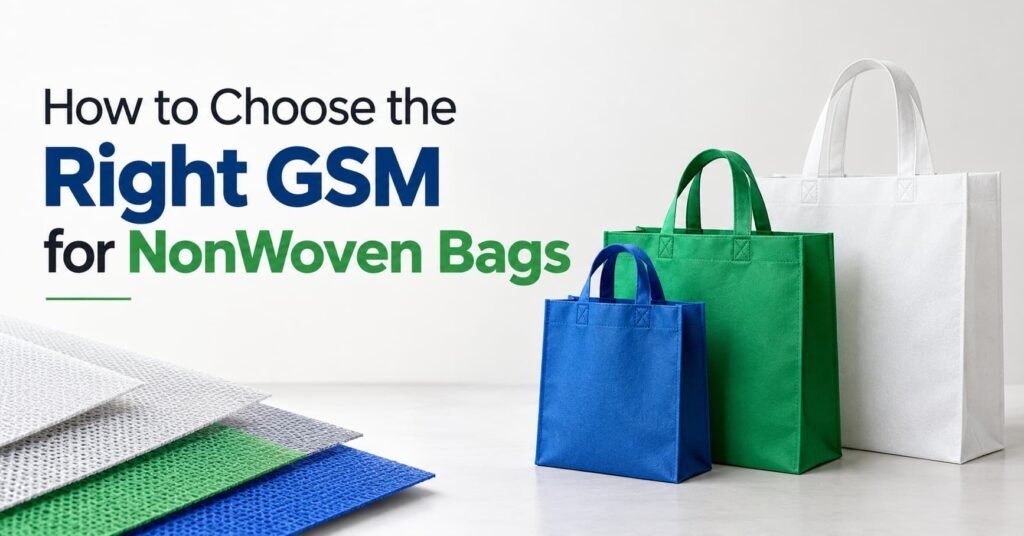
Two nonwoven bags may appear the same, but one may get torn after a few usages, whereas the other may last a long time. The major factor that makes the difference is definitely GSM. Thus, it is critical to understand how to choose the right GSM so that you can achieve durable and strong bags at a reasonable price.
Quick answer: It is wise to choose a GSM of 70 to 90 for an average reusable shopping bag. You can choose a GSM of 60 to 70 for light bags and 90 to 120 for heavy bags. In India, nonwoven carry bags must also meet the minimum GSM set under the Plastic Waste Management Rules (60 GSM as per the 2021 amendment).
What Is GSM in NonWoven Bags?
GSM indicates how many grams one square metre of the fabric weighs. For example, 1 square metre of 80 GSM nonwoven material weighs 80 grams.
- Lesser GSM (for example, 40-60) = thinner, lighter, and softer fabric.
- Higher GSM (for example, 90-120) = thicker, stiffer, and typically stronger fabric.
Fabric GSM vs. bag weight: GSM is applicable to fabric and not the bag itself. The bag weight depends on its dimensions, gussets, handles, and additional layers. Hence, a big bag made of 70 GSM fabric can weigh more than a small bag made of 100 GSM fabric. Therefore, it is recommended to ask for the GSM fabric and not only the bag’s weight.
Why Does GSM Matter When Choosing Nonwoven Bags?
- Strength and load capacity: Heavier GSM fabric tends to be able to carry more weight and thus avoid ruptures.
- Texture and aesthetic: Heavier GSM appears bulkier and more high-end. Lighter GSM looks thin and soft.
- Repeat usage and durability: Thicker fabric means more uses.
- Printing and branding: Higher GSM material is able to present the logo better in terms of clarity and sharpness due to the smoothness of the surface.
- Price and budget: Higher GSM equals the weight of the material used and therefore increases the price considerably, particularly in large volume orders.
How to Choose GSM for Different Types of Nonwoven Bags
| Bag type | Suggested GSM | Typical use |
| D-cut and W-cut carry bags | 60-70 | Retail shops, pharmacies, light grocery |
| U-cut and loop-handle bags | 70-90 | Clothing stores, boutiques, gifting |
| Grocery and vegetable bags | 80-100 | Supermarkets, daily heavy shopping |
| Promotional and event bags | 70-90 | Exhibitions, conferences, giveaways |
| Box bags and premium bags | 90-120 | Sweets, jewellery, premium retail |
| Heavy-duty or laminated bags | 100-150+ | Bulk items, long-term reuse |
How to Calculate the GSM You Need for Your Business
Follow the steps outlined below:
- Take into account the items that the bag will hold. Examples of such items include garments and goods from grocery shops as well as cartons.
- Decide how many times it will be reused: once, several times or for several months.
- Pick a starting GSM from the table above.
- Request for samples in two GSM values. For instance, select 70 and 90 GSM.
- Conduct a testing experiment using physical load and opt for the minimum GSM value that is tested successfully.
Example: How much fabric does a bag use?
A flat bag with dimensions of 40 cm × 50 cm contains two panels, so the fabric used amounts to 0.4 × 0.5 × 2 = 0.4 square metres.
- For GSM of 70, the bag will require about 28 grams of the material.
- For a GSM of 90, it will be equal to 0.4 × 90 = 36 grams for each bag
For 10,000 bags, that is 280 kg of fabric at 70 GSM and 360 kg at 90 GSM.
What Other Factors Affect Nonwoven Bag Strength?
The following are the other considerations that must be taken into account apart from GSM:
- Size and shape of the bag: Larger bags mean more weight and require stronger material. Gussets help to distribute the weight.
- Quality of polypropylene: Bags made of virgin polypropylene are usually tougher than those made of fillers or recycled material.
- Type of handle and its attachment: Loop and box bag handles distribute weight better than D-shaped handles. The way a bag handle is attached is as important as fabric material.
- Stitching and bonding: Ultrasonic bonding provides a clean result, whereas stitched seams and reinforced handle seams can bear heavier weight.
- Finish and lamination: Laminated nonwoven fabrics are stiffer and more water-proof, thus making great fabrics for premium or heavy-use bags.
- Quality inspection and load test: Load test is the most reliable way to check the strength of bags.
How to Calculate the GSM You Need for Your Business
The cost of nonwoven fabric is generally on a per-kilo basis; therefore, fabric with a higher GSM is more likely to result in a higher bag cost. In the example provided above, when the GSM increased from 70 to 90, about 29% more fabric is required for that increase. Additional costs are incurred due to printing, handles, stitching, lamination, etc. Read more about what affects nonwoven fabric cost.
How to Choose a Reliable Nonwoven Bag Manufacturer
Whether you buy finished bags or fabric to make your own, check that your nonwoven bags manufacturer or fabric supplier offers:
- Correct GSM: The fabric should have the actual GSM and should not oversell it.
- Quality material: Look for 100% virgin polypropylene.
- Colour and width choice: There should be a good selection of colours, widths, and finishes available.
- Samples: Ask for samples before placing bulk orders.
- Clarity about MOQ and timelines: Be sure to know about the minimum order and delivery schedule.
- Consistency: There must be uniformity in quality between the repeat orders.
Metro Plasto from Bhiwani, Haryana, has been manufacturing PP spunbond nonwoven fabric since 2011. Our fabric is 100% virgin polypropylene and is available in a wide range of colours for shopping bags and packaging. Bag makers across India use our fabric to produce strong, reliable nonwoven bags.
Frequently Asked Questions
What does GSM mean in nonwoven bags?
GSM stands for grams per square metre. It indicates the weight and thickness of the fabric.
Which GSM is best for reusable shopping bags?
GSM between 70 and 90 is ideal for most reusable shopping bags. For heavy punishment, the GSM must be 90 and above.
Are higher GSM nonwoven bags always stronger?
Not necessarily. Other factors such as fabric quality, bag style, handle construction, and seam sewing will affect strength. A good 80 GSM bag can be better than a poorly made 100 GSM bag.
What is the difference between 60 GSM and 100 GSM bags?
A 60 GSM bag is made of seemingly less material and less sturdy than a 100 GSM bag. Thus, it is appropriate for lightweight goods and short-term use, while the 100 GSM one is great for heavy goods and prolonged usage.
Does GSM affect the cost of nonwoven bags?
Yes. The higher the GSM, the more material used in producing each bag, so it is more expensive.
How can I test the strength of a nonwoven bag?
Fill in your bag with real goods or something much heavier. Lift it more than once and see if it allows your hands to stretch or tear.
Conclusion
Selecting the correct GSM is crucial for purchasing nonwoven bags that are durable, visually appealing, and economical. 60 GSM to 70 GSM is the recommended GSM for light-duty bags, 70 GSM to 90 GSM for general purpose bags, and 90 GSM or more for heavy and premium bags. It is essential to keep in mind the quality of the nonwoven material used, the kind of handles used for lifting bags, and the techniques employed to sew the bags while placing bulk orders.
Looking for high quality nonwoven fabric for your bags? Contact Metro Plasto for samples and a quick quote.