
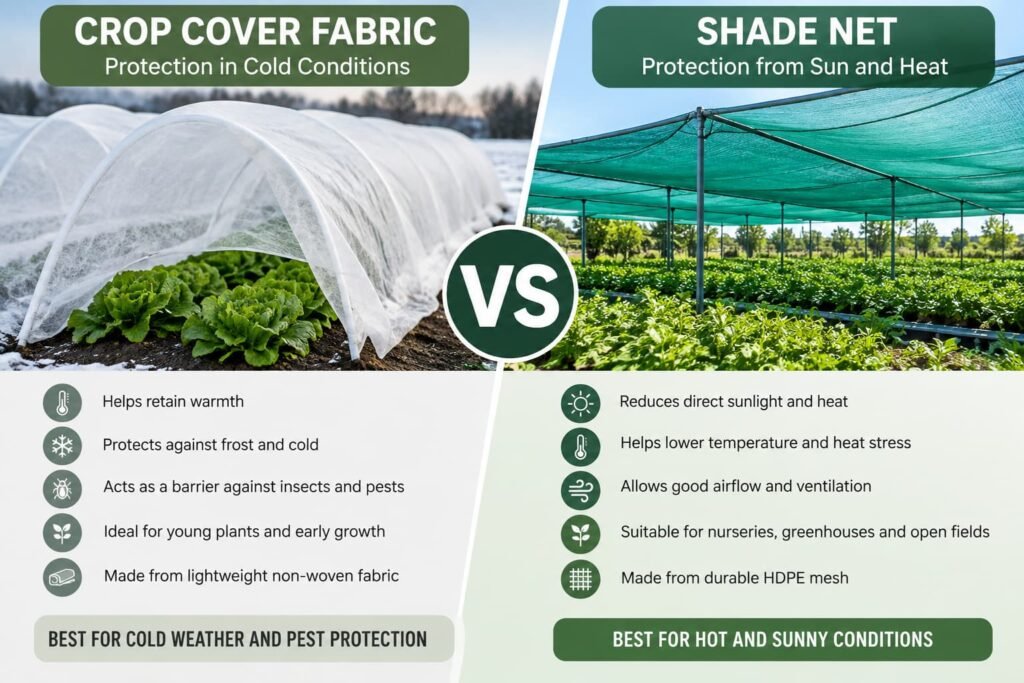
If you’ve searched for crop cover fabric vs shade net, you’re probably trying to solve a specific growing problem. Maybe your seedlings are getting scorched, you’re worried about unexpected frost, insects are damaging your crops, or strong winds are causing problems.
Both materials can protect crops, but they work in different ways. Choosing the right one can help create better growing conditions, protect your plants, and prevent unnecessary spending.
This guide explains the main differences between crop cover fabric and shade net, including their uses, protection levels, airflow, durability, cost, and suitability for different growing conditions.
What Is Shade Net?
Shade net, also known as agro shade net or garden shade net, is a knitted or woven mesh generally made from HDPE (high-density polyethylene). It is commonly UV stabilized to make it more durable when exposed to sunlight.
Its main purpose is to reduce the amount of sunlight and heat reaching plants. It can help lower plant and soil temperatures while reducing water loss caused by evaporation.
Because shade net has an open mesh structure, it allows plenty of airflow and lets some light and rain pass through. This makes it useful for:
- Nurseries
- Greenhouses
- Open-field crops
- Seedling protection
- Hot-weather crop production
How Does Shade Percentage Work?
Shade net is available in different shade percentages, commonly 35%, 50%, 75%, and 90%.
The shade percentage indicates how much sunlight the net is designed to block.
- 35% to 50% shade: Suitable for crops that need plenty of light but still need some protection from heat and intense sunlight.
- 50% to 75% shade: Commonly used for nurseries, seedlings, ornamentals, and shade-tolerant vegetables.
- 75% to 90% shade: Used for crops and applications that need a significant reduction in sunlight, such as certain orchid houses and mushroom-growing environments.
Choosing a shade percentage that is too high can reduce the amount of light available to plants and may affect their growth.
Common Types of Shade Net
Shade nets are available in several colors and designs, including:
- Green shade net
- Black shade net
- White shade net
- Silver or reflective shade net
The best option depends on the crop, climate, growing environment, and the level of light and heat control needed.
What Is Crop Cover Fabric?
Crop cover fabric, also known as row cover, garden fleece, or floating row cover, is generally made from lightweight non-woven polypropylene.
Unlike shade net, crop cover fabric is mainly designed to create a protective barrier around plants and help retain warmth.
It is commonly used for:
- Frost protection
- Cold-weather protection
- Season extension
- Insect exclusion
- Protecting young plants
One of its main advantages is that, when properly installed, crop cover fabric can physically prevent certain insects and pests from reaching crops.
Non-Woven vs Woven Crop Cover Fabric
Most crop cover fabrics are made from non-woven polypropylene and have a lightweight, fleece-like appearance.
They can be:
- Placed directly over crops
- Installed over hoops
- Used as floating row covers
Woven crop covers are also available and may provide greater durability. However, they are generally heavier and less commonly used for direct contact with crops.
What Does GSM Mean for Crop Cover Fabric?
Crop cover fabric is commonly specified by GSM (grams per square meter). GSM indicates the weight and thickness of the fabric.
Common ranges include:
- 17 to 20 GSM: Lightweight protection, suitable for insect exclusion and light frost protection.
- 25 to 35 GSM: Medium-weight fabric that offers greater cold and frost protection while still allowing reasonable light transmission.
- 50 GSM and above: Heavy-duty protection for stronger cold and frost conditions. However, it can reduce light transmission more significantly.
A heavier fabric is not always better. If it stays over the crop for too long, reduced light can affect plant growth.
Crop Cover Fabric vs Shade Net: Quick Comparison Table
| Factor | Shade Net | Crop Cover Fabric |
|---|---|---|
| Primary purpose | Reduce light and heat | Retain warmth and provide protection |
| Best for | Heat stress, sun protection, nurseries | Frost, cold weather, pest exclusion |
| Material | HDPE knitted/woven mesh | Non-woven polypropylene |
| Airflow | High | Moderate to low |
| Frost protection | Minimal | Good for light to moderate frost |
| Insect exclusion | Low with standard shade net | Moderate to good when properly sealed |
| Typical lifespan | Around 3 to 5 years | Often 1 to 2 seasons |
| Common rating | Shade percentage, such as 35% to 90% | GSM, such as 17 to 50+ |
Which One Should You Choose?
The right material depends mainly on the problem you’re trying to solve.
If You’re Protecting Against Heat and Sun Scorch
Choose shade net.
Select the shade percentage according to the crop’s light requirements and local climate. Lower shade percentages may work better for crops that need strong sunlight, while higher percentages are more suitable for shade-tolerant crops and certain nursery applications.
If You’re Protecting Against Frost or Cold Snaps
Choose crop cover fabric.
Select the GSM according to the expected weather conditions. Once the cold or frost risk has passed, remove the cover when appropriate so plants receive enough light and ventilation.
If You’re Dealing With Pests or Insects
Crop cover fabric can provide a useful physical barrier when the edges are properly sealed.
For significant insect pressure, however, a dedicated insect mesh may provide more targeted protection.
If You Need Wind Protection
Shade net can help reduce wind intensity while still allowing airflow through its mesh structure.
Proper installation and secure fastening are important, especially in areas exposed to strong winds.
If You’re Growing Year-Round
You may benefit from using both materials at different times of the year.
For example:
- Shade net during periods of high heat
- Crop cover fabric during cold weather
- Crop cover fabric during early planting
- Shade net during peak summer conditions
Can You Use Both Together?
Yes, but using both at the same time is not always necessary.
A seasonal approach can be more practical:
- Early spring: Use crop cover fabric to protect young plants from cold and frost.
- Stable temperatures: Remove the crop cover when conditions become suitable.
- Peak summer: Install shade net to reduce heat and intense sunlight.
- Autumn: Use crop cover fabric again when temperatures begin to fall.
Using both materials together can reduce light and airflow too much, so switching between them according to seasonal conditions is often more practical.
Read also: Non Woven Fabric Manufacturer in Bhiwani, Haryana for Bulk & Custom Orders
Common Mistakes Growers Make
Choosing the Highest Shade Percentage
More shade is not automatically better. Using a very high shade percentage on a crop that requires strong light can affect growth.
Leaving Crop Cover Fabric on Too Long
Once frost or cold conditions have passed, leaving the fabric installed unnecessarily can reduce light and increase heat or humidity.
Assuming Shade Net Stops Insects
Standard shade net is not designed primarily for insect exclusion. Its mesh openings may allow small insects to pass through.
Not Securing Crop Cover Fabric Properly
Gaps around the edges can allow insects and cold air to enter, reducing the effectiveness of the cover.
Ignoring GSM
When purchasing crop cover fabric, do not look only at the product name. Check the GSM, because different weights provide different levels of protection.
Quick Decision Checklist
Use this simple checklist:
- Main problem is heat or strong sunlight? Choose shade net.
- Main problem is frost or cold? Choose crop cover fabric.
- Need multi-season durability? Shade net may be more suitable.
- Need insect exclusion? Choose crop cover fabric or dedicated insect mesh.
- Need strong airflow? Choose shade net.
- Need year-round protection? Consider using both at different times of the year.
Frequently Asked Questions
Can Shade Net Protect Plants From Frost?
Not effectively. Shade net has an open mesh structure and does not provide significant insulation. Crop cover fabric is generally more suitable for frost protection.
What GSM Crop Cover Fabric Do I Need for Frost Protection?
Lightweight 17 to 20 GSM fabric can be used for lighter frost protection, while 25 to 35 GSM and heavier fabrics can provide greater protection in colder conditions. Actual performance depends on the material, installation, crop, and weather conditions.
Does Shade Net Stop Insects and Pests?
Standard shade net generally does not reliably stop small flying insects because its openings are designed primarily for shade and airflow. For pest exclusion, consider crop cover fabric or dedicated insect mesh.
How Long Does Shade Net Last Compared to Crop Cover Fabric?
UV-stabilized shade net can commonly last around 3 to 5 years with appropriate installation and care. Crop cover fabric, particularly lightweight varieties, may typically last around 1 to 2 seasons.
Can I Use Shade Net and Crop Cover Fabric at the Same Time?
It is possible, but usually unnecessary. Using both at the same time can restrict light and airflow. In many growing situations, it is more practical to use them at different times of the year.
Which Is Cheaper: Shade Net or Crop Cover Fabric?
Crop cover fabric may cost less initially but generally requires more frequent replacement. Shade net may have a higher upfront cost but can provide better cost efficiency over multiple seasons because of its longer lifespan.