
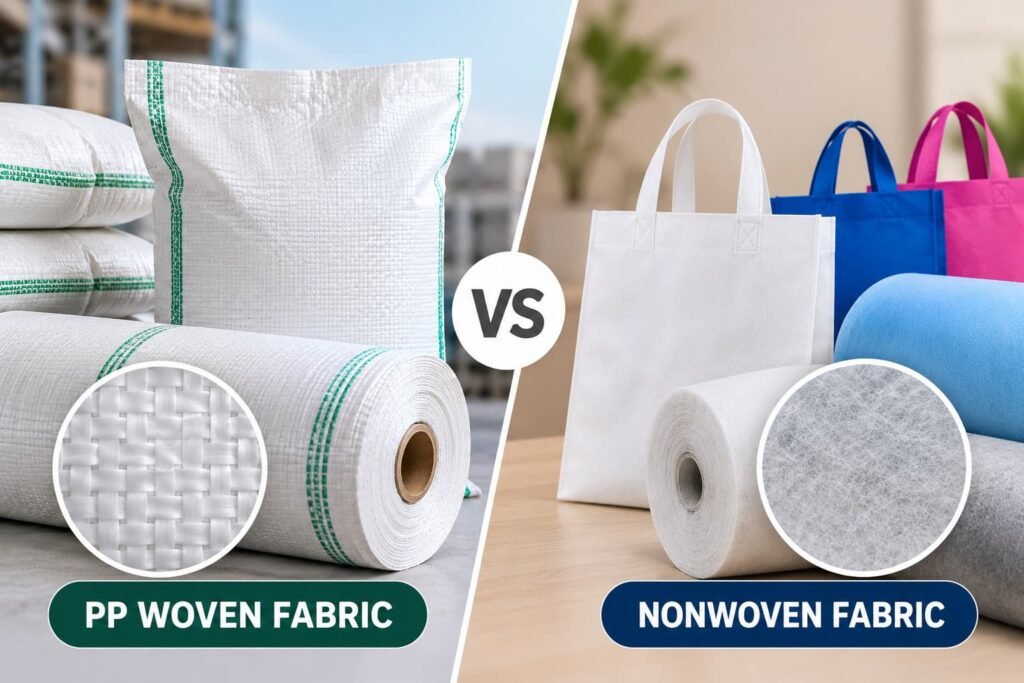
At first glance, PP woven and nonwoven fabrics may look a like, but the manufacturing process is quite different, and this has an effect on the strength and durability. Hence, both are utilised for manufacturing bags and packaging.
The main difference between PP woven and nonwoven fabric is how they are made. PP woven fabric has been produced by interlacing existent polypropylene tapes; hence, it possesses high strength, which makes it suitable for heavy-duty sacks. Nonwoven fabric is made by melting and bonding fibres together, resulting in a lighter, softer material used for bags, hygiene products, and medical supplies. In this guide, we present details about the production methods of each of them and draw up their strengths and purposes.
What Is PP Woven Fabric?
PP woven fabric is a durable fibre produced by weaving flat polypropylene (PP) tapes in a manner similar to how traditional fabrics are woven in the loom.
How it is made: The process involves heating polypropylene until it extrudes into a thin film. The film goes through a slit and is cut into small tapes that are stretched to make them stronger and then woven in a criss-cross pattern on circular or flat looms. The fabric can also be laminated or coated to make it water-resistant.
Key properties:
- High tensile strength and tear resistance
- Very low elasticity under heavy loads
- Durable and long-lasting, even with rough handling
- Resistance to moisture through lamination
Common uses: woven sacks for grain, sugar, fertiliser, and cement; bulk bags (FIBCs or jumbo bags); and heavy-duty reusable shopping bags.
What Is Nonwoven Fabric?
Nonwoven fabric is created by using heat, chemicals, or pressure to bond fibres together instead of using knitting or weaving techniques.
How it is made: The two most common methods are:
- Spunbond: Polymers such as polypropylene can be melted and extended into long filaments, after which these filaments are laid down to form a web and bonded through heat and pressure. Spunbond fabric is popular thanks to its great strength despite its low weight.
- Meltblown: In this method, the polymer is blasted into very thin fibres, creating a dense web as output. Meltblown fabric is a highly effective filtering material. Thanks to its good filtering properties, meltblown is often used in mask production and is normally layered with spunbond (SMS fabric).
Key properties:
- Lightweight and soft.
- Breathable.
- Available in a wide range of thicknesses (GSM) and colours
- Easy to cut, stitched, heat-seal and print.
- Cost-effective solution for large volumes.
Common uses: shopping and carrying bags; hygiene products such as diapers and wipes; and medical items such as masks, gowns, and caps, crop covers, and packaging.
Difference Between PP Woven and Nonwoven Fabric
Here is a side-by-side look at the difference between PP woven and nonwoven fabric:
| Feature | PP Woven Fabric | Nonwoven Fabric |
| How it is made | Polypropylene tapes woven on a loom | Fibres bonded by heat, pressure or chemicals |
| Structure | Visible criss-cross weave | Smooth, felt-like sheet |
| Strength | Very high tensile strength | Moderate; depends on GSM and bonding |
| Stretching | Very little | More flexible |
| Feel | Stiff and slightly rough | Soft and lightweight |
| Breathability | Low | High |
| Water resistance | Good, excellent when laminated | Water-resistant, but not fully waterproof unless laminated |
| Printing | Good, often with lamination | Easy, with screen or flexo printing |
| Cost | Higher per unit for heavy-duty bags | Lower for light and medium-duty uses |
| Best for | Heavy loads, industrial and agricultural sacks | Shopping bags, hygiene, medical and agriculture covers |
PP Woven vs Nonwoven: Which Is Stronger?
PP woven fabric is generally stronger than nonwoven fabric, especially for carrying heavy loads.
Why PP woven is used for heavy loads: The woven straps keep their strength as they are woven in two directions, thus ensuring equal weight distribution throughout the fabric. As a result, the material has good tensile strength and hardly any stretch, which is why it can be naturally applied to sacks and big bags weighing between 25 kg and 50 kg.
What decides nonwoven strength? Nonwoven fabric can still be strong for everyday use. Here are the factors affecting the strength of nonwoven fabric:
- Weight of the textile (GSM): The heavier the textile is, the more durable it is.
- Type of bonding: Spunbond is way stronger than meltblown.
- Quality of the fibres: Virgin polypropylene performs better than recycled ones or those that contain additives.
Always check the load capacity: Regardless of the fabric you choose, it is strongly advised to test the finished bag with the actual weight it should be able to carry. The sewing technique, the design of the handles, and the bag size are as important as the fabric itself.
PP Woven vs Nonwoven Bags: Which Should You Choose?
Choose nonwoven bags for retail, promotional and light grocery use. Choose PP woven bags for heavy-duty, industrial and bulk packaging.
| Bag type | Better choice | Why |
| Reusable shopping bags | Nonwoven (or PP woven for heavy groceries) | Light, soft and easy to carry; PP woven lasts longer under heavy loads |
| Promotional and event bags | Nonwoven | Low cost, many colours and easy to print with logos |
| Grocery and retail carry bags | Nonwoven | Cost-effective for daily use and bulk orders |
| Grain, fertiliser and cement sacks | PP woven | High strength and resistance to tearing |
| Bulk bags (jumbo bags) | PP woven | Built to carry very heavy loads |
Key points to compare:
- Expected load: Lightweight products can be stored in nonwoven bags, while heavy or sharp products require bags made from PP woven material.
- Reuse frequency: PP woven bags last longer; for moderate reuse, a good GSM nonwoven bag works well.
- Printing: Nonwoven bags are easier and cheaper to print with various colors.
- Budget: Nonwoven bags are usually less expensive compared to retail and promotional bags.
Uses of PP Woven and Nonwoven Fabrics
PP Woven Applications
- Fertiliser, grain, and cement packaging: This type of sack is durable and ideal for all types of heavy and dense products.
- Industrial and agricultural sacks: These sacks include sugar, rice, animal feed, seeds, chemicals, and sand.
- Reusable shopping bags: It offers highly durable and reusable sacks for shopping.
Nonwoven Applications
- Shopping and promotional bags: D-cut, W-cut, loop bag, and box bag designs. See our nonwoven fabric for shopping bags.
- Hygiene and selected medical products: It includes diapers, pads, wipes, masks, surgical clothes, etc. See our medical and hygiene fabrics.
- Filtration, agriculture, and protective coverings: It is used in air and water filtration devices, plant protection, mulching, frost covering, etc. See our agriculture fabrics.
Nonwoven fabric is also widely used in packaging, furniture and mattress covers, and upholstery.
Factors to Consider Before Choosing a Fabric
• Required strength and load capacity: How much weight will the bag be bearing? The heavy loads imply that we should go for PP woven bags.
• Fabric weight and thickness: Check the GSM. The higher the GSM, the thicker and stronger the fabric, but the greater will be its cost.
• Water resistance and environment: If needed, storage is exposed to moisture; laminated PP woven or laminated nonwoven must be chosen.
• Printing and customisation: For bright multiple-colour logos, nonwoven printing is usually easier and cheaper.
• Cost per bag or packaging unit: Evaluate the end cost of the bag instead of the price per kilogram of fabric.
• Reusability and end-of-life disposal: Since both fabrics are made of polypropylene, it can be recycled when such possibility occurs.
Want to understand pricing in more detail? Read our guide on how much nonwoven fabric costs.
How to Choose a Nonwoven Fabric Manufacturer or Supplier in India
Choosing the right supplier greatly enhances the quality, consistency, and cost of your final product. These steps should guide you:
- Check product specifications and material composition: You should inquire whether the fabric is composed entirely of virgin polypropylene.
- Ask about GSM, width, colour, and finishes: Verify with the supplier that they are able to provide you with the required GSM, roll width, colours, and finishes.
- Request samples before bulk orders: It is recommended that you check how strong the samples are, whether the colours are consistent, and how effectively they can be printed and sewn.
- Confirm MOQ, capacity, and delivery timelines: Find out the MOQ, the production capacity for a month, and how fast the supplier is able to deliver the orders.
Metro Plasto: PP Spunbond Nonwoven Fabric Manufacturer
Metro Plasto, headquartered in Bhiwani, Haryana, has been manufacturing PP spunbond nonwoven fabric since 2011. Our fabric rolls are made out of 100% virgin polypropylene and come in a variety of colours, including UV-stabilised shades and customised colours. We sell fabric for shopping bags, medical and hygiene products, agriculture, packaging, furniture, and industrial applications in India.
Frequently Asked Questions
What is the main difference between PP woven and nonwoven?
The main difference is how they are made. PP woven is made by interweaving polypropylene strands, while nonwoven is made by fusing fibres together without interweaving. Consequently, the PP woven material is more durable, while the nonwoven material is lighter, softer, and more breathable.
Is PP woven fabric stronger than nonwoven fabric?
Yes. The PP woven fabric usually has better tensile strength and less elastic property, which makes it more suitable for heavy-duty work. The strength of nonwoven depends on its GSM, bonding technology, and fibre properties.
Are PP woven and nonwoven fabrics both made from polypropylene?
PP woven fabric is always made from polypropylene. Nonwoven fabric is mostly made from polypropylene but can also be made from other kinds of fibres like polyester and viscose.
Which fabric is better for shopping bags?
Nonwoven fabric is considered suitable for commercial purposes, including the retail, grocery, and promotional bags because it is lightweight, affordable, and easy to print. PP woven fabric is more suitable to be used for heavy-duty shopping bags that can carry heavy loads.
Which fabric is suitable for heavy-duty packaging?
PP woven is the most suited fabric for heavy-duty bags, for instance, sacks for cement, fertiliser, grain, animal feed, and bulk packaging.
Is nonwoven fabric waterproof?
Standard nonwoven fabric is water-resistant but not 100% waterproof. because it is breathable. However, laminated and coated nonwoven fabrics provide better protection against the water.
What is the difference between woven and nonwoven bags?
Woven bags are made by weaving polypropylene plastic tapes and are sturdy, rigid, and good at carrying loads. However, nonwoven bags are made from bonded fabric and are lightweight, soft, cost-effective, and easier to print.
Conclusion
The difference between PP woven and nonwoven fabrics lies in their manufacturing technique and purposes. PP woven fabric proves to be the better choice in applications such as heavy and bulk sacks as well as in industrial packaging. Nonwoven fabric is known to be lighter and softer and easier to print and among the most affordable for shopping bags and other uses.
Before making a decision, consider the load, GSM, water resistance, printing requirements, and price per bag. Always test a sample first.
Looking for reliable PP spunbond nonwoven fabric for your bags or products? Contact Metro Plasto for samples and a quick quote.