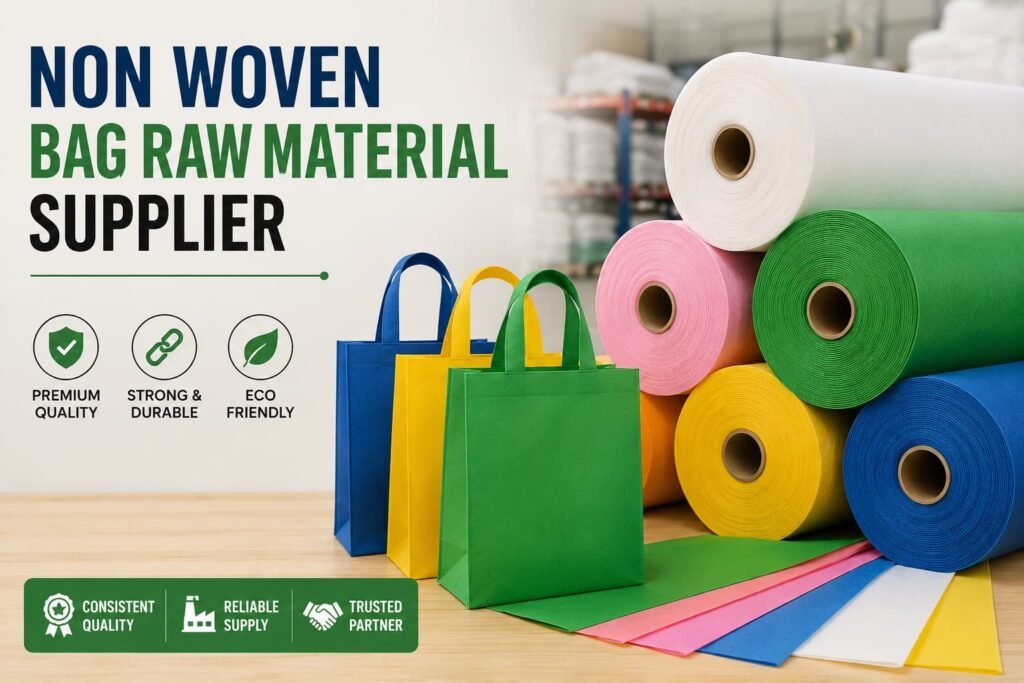
Finding a dependable non woven bag raw material supplier can have a big impact on your bag manufacturing business. Whether you make shopping totes, grocery bags, or branded promotional carriers, the material you use affects strength, print quality, cost per unit, and how eco-friendly the finished bag really is. This guide takes you through the main raw material options, including PP spunbond, laminated non-woven, RPET, paper, cotton, and jute. It also covers GSM comparisons, quality checks, certifications, and a supplier checklist to help you make a better buying decision.
Why Raw Material Selection Matters for Bag Manufacturing
The fabric you choose affects almost every part of the finished bag. It decides how the bag feels in the customer’s hand, how well it handles regular use, and how long it can last.
Manufacturers who don’t pay enough attention to raw material quality often face problems later. These can include rejected batches, faded prints, or bags that tear at the seams during their first use.
Working with an established non woven bag raw material supplier can help avoid many of these issues. A good supplier should provide consistent GSM, reliable fiber quality, and accurate roll width from one batch to the next. This gives you more predictable production, fewer rejected bags, and fewer complaints from customers.
The raw material you choose also has a direct effect on your costs. PP non-woven fabric, paper, cotton, and jute all come at different price points. When you are buying in large quantities, even a small price difference can have a major effect on your total cost. Choosing the right material from the beginning can help protect your profit margins.
Types of Bag Raw Materials
Bag manufacturers generally use six main types of materials. Each one works better for different needs, budgets, and levels of durability. A reliable bag raw material supplier will usually offer several of these options because manufacturers often produce different types of bags.
- PP Spunbond Non-Woven – One of the most commonly used materials for shopping bags. It is lightweight, water-resistant, and cost-effective for large orders.
- Laminated Non-Woven – PP spunbond fabric with a BOPP film layer. It gives the bag a smooth, glossy surface, better printing quality, and extra water resistance.
- RPET Non-Woven – Made from recycled PET bottles. It is a popular choice for brands that want to include recycled materials in their products.
- Paper (Kraft) – Recyclable and very good for detailed printing, but it becomes weaker when it gets wet.
- Cotton (Canvas / Calico) – A strong natural fabric that is made for repeated use and is often used for premium bags.
- Jute – A coarse, biodegradable natural fiber that is commonly used for eco-friendly, premium, and gifting bags.
Each material has its own advantages and limitations, so comparing them before placing an order is important.
Raw Material Comparison Table
The table below compares the six materials based on the factors that usually matter most when choosing PP non woven fabric, paper, cotton, or jute for bulk production.
| Material | Typical GSM Range | Printability | Durability | Relative Cost | Common Applications |
|---|---|---|---|---|---|
| PP Spunbond Non-Woven | 60–100 GSM | Good flexo & screen print | Moderate-High (20–50+ reuses) | Low | Retail & grocery shopping bags, event giveaways |
| Laminated Non-Woven | 80–120 GSM + BOPP film | Excellent photo-quality via lamination | High – water & tear resistant | Medium-High | Premium branded bags, wine & gift bags |
| RPET Non-Woven | 80-150 GSM | Very Good | High | Medium-High | Eco-branded retail, cosmetics, fashion |
| Paper (Kraft) | 70-150 GSM | Excellent – offset & letterpress | Low-Moderate (weak when wet) | Low-Medium | Boutique retail, food takeaway packaging |
| Cotton (Canvas) | 100-300+ GSM | Good – screen printing standard | Very High machine washable | High | Premium reusable totes, fashion merchandise |
| Jute | 200-600+ GSM | Fair – screen print only | Very High rugged, biodegradable | Medium-High | Eco-premium bags, produce & wine bags |
Takeaway: If your main priority is low cost and fast printing, PP spunbond non-woven is a strong choice. If your buyer wants a documented recycled-content percentage, RPET is a popular option among non woven bag raw material supplier..
Latest Non-Woven Bag Material Trends
Three important changes are influencing what a non woven bag raw material supplier keeps in stock this year.
Recycled content is becoming more than just a marketing point. It is now often included in the product specifications. Non-woven and RPET fabrics made with recycled plastic content are becoming more common. RPET, in particular, is now widely requested by cosmetics, fashion, and grocery brands that want to show customers that their products contain recycled materials.
Regulations are also influencing demand. Single-use plastic bag restrictions are now in place in many countries, while extended producer responsibility rules are expanding into more markets. As a result, buyers are asking about recyclability and material content earlier in the sourcing process.
The supply side is changing too. Larger packaging companies are acquiring regional non-woven specialists, while some manufacturers are bringing raw material production and bag manufacturing under one roof. For buyers, this can mean more consistent quality from established suppliers. However, it is still a good idea to work with more than one non woven bag raw material suppliers so you have options for pricing and supply.
How to Choose the Right Raw Material for Different Industries
There is no single “best” raw material for every bag. The right choice depends on what the bag needs to handle and how it will be used.
- Grocery & Retail: 80–100 GSM PP spunbond non-woven is still a common choice. It can hold 5–8 kg comfortably, prints well in one or two colors, and keeps the cost low for large orders.
- Fashion & Boutique Retail: Cotton canvas or laminated non-woven works well when the look and feel of the bag are important. Brand image often matters more than the lowest possible unit cost.
- Food & Beverage: Kraft paper or laminated PP can be good choices because they provide a smooth surface for detailed printing and are easier to use for food-related packaging.
- E-commerce & Shipping: 120–150+ GSM non-woven or RPET can provide the extra strength needed to handle transportation and delivery.
- Corporate & Promotional: 60–80 GSM PP non woven fabric is suitable when large quantities are needed at a low cost.
- Pharma & Healthcare-Adjacent: Laminated non-woven or medical-grade spunbond should be selected based on the required safety and compliance standards.
For these types of bag manufacturing materials decisions, it is better to request samples for your specific application instead of choosing only from a general swatch card.
Printing Compatibility by Material
The printing method you use depends heavily on the material. Choosing the right fabric first makes it easier to choose the right printing process.
- Screen Printing: Commonly used for PP spunbond, cotton, and jute. It works well on textured surfaces and is cost-effective for smaller orders, although it is usually limited to one to four spot colors.
- Flexographic Printing: Common for high-volume PP non woven rolls produced at the fabric mill. It is fast and works well for large grocery-bag orders.
- Offset & Digital Printing: Mostly used for laminated non-woven and kraft paper because both provide smooth surfaces for detailed, multi-color designs.
- Heat Transfer: A useful option for small custom orders on PP or laminated PP, especially when you need full-color artwork.
If your design includes gradients, photographs, or more than five colors, plain PP spunbond may not be the best option. Laminated non-woven could give you a better result. It is worth discussing the artwork with your bag raw material supplier before production begins.
Quality Parameters Every Buyer Should Verify
Supplier specification sheets do not always tell the whole story. Before approving a bulk non woven fabric order, check the actual material whenever possible.
- Actual GSM, not just stated GSM – Cut a 10cm × 10cm piece, weigh it, and multiply the result by 100. For example, if a fabric advertised as “100 GSM” weighs only 0.8g for that sample, the actual GSM is 80.
- Tensile and seam strength – Pay special attention to the handle attachment areas because these are common points where bags can fail.
- Colorfastness – Printed colors should not easily crack, fade, or transfer when the fabric is folded or rubbed.
- Roll width and length consistency – Consistent roll sizes help prevent material waste during cutting.
- Fiber uniformity – Hold a sample up to the light and look for thin areas, gaps, or uneven sections.
- Odor and chemical residue – This is particularly important for food-related products and children’s products.
- Recycled-content documentation – For RPET, ask for proper documentation showing the recycled content instead of relying only on a verbal claim.
- Batch-to-batch consistency – Request samples from at least two different production runs before entering into a long-term agreement.
A non woven bag raw material supplier that is serious about long-term business should be able to provide test data and samples when requested.
Certifications & Compliance Standards
Certifications do not tell you everything about a non-woven fabric manufacturer, but they can help you understand how seriously a supplier takes quality and compliance.
Depending on your target market, a serious PP non woven fabric supplier should be able to provide:
- ISO 9001 – Shows that the supplier has a documented quality management system. ISO 9001 explained is a useful starting point if you are new to these certificates.
- REACH Compliance – Important for raw materials entering the EU market. It covers restrictions on certain hazardous chemical substances. ECHA’s REACH overview provides more information.
- SGS or equivalent third-party test reports – Independent laboratory testing can verify GSM, tensile strength, and chemical safety instead of relying only on the supplier’s own test results. SGS is a well-known testing organization, although reports from other accredited laboratories can also be acceptable.
- OEKO-TEX Standard 100 – Mainly relevant for cotton and other fabrics that come into contact with skin. It confirms that the material has been tested for harmful substances.
- BSCI or similar social compliance audits – These are increasingly requested by Western retail buyers along with material certifications.
Always ask for certificate numbers rather than relying only on logos shown on a supplier’s website. Many certification organizations allow you to verify certificates through their public databases.
Bulk Procurement Guide for Non-Woven Bag Raw Materials
Buying large quantities requires more planning than buying a small trial order. If you are comparing several non woven bag raw material supplier, make sure you discuss the following points before placing your purchase order:
- MOQ – Minimum order quantities are often around 500kg to a few tons for each color/GSM combination. Custom colors may require higher quantities.
- Lead time – Allow around 15–30 days for production plus shipping. Custom lamination or printing may take longer.
- Payment terms – TT (bank transfer) is common for repeat orders, while letters of credit are more common for some first-time, high-value purchases.
- Incoterms – Check whether the quoted price is FOB, where you arrange shipping, or CIF, where the supplier arranges it. This can make a big difference to your final landed cost.
- Sampling first – Always request a physical fabric sample and, if possible, a finished bag sample before placing a bulk non woven fabric order. A sample lets you check the actual feel, thickness, and color instead of relying only on a specification sheet.
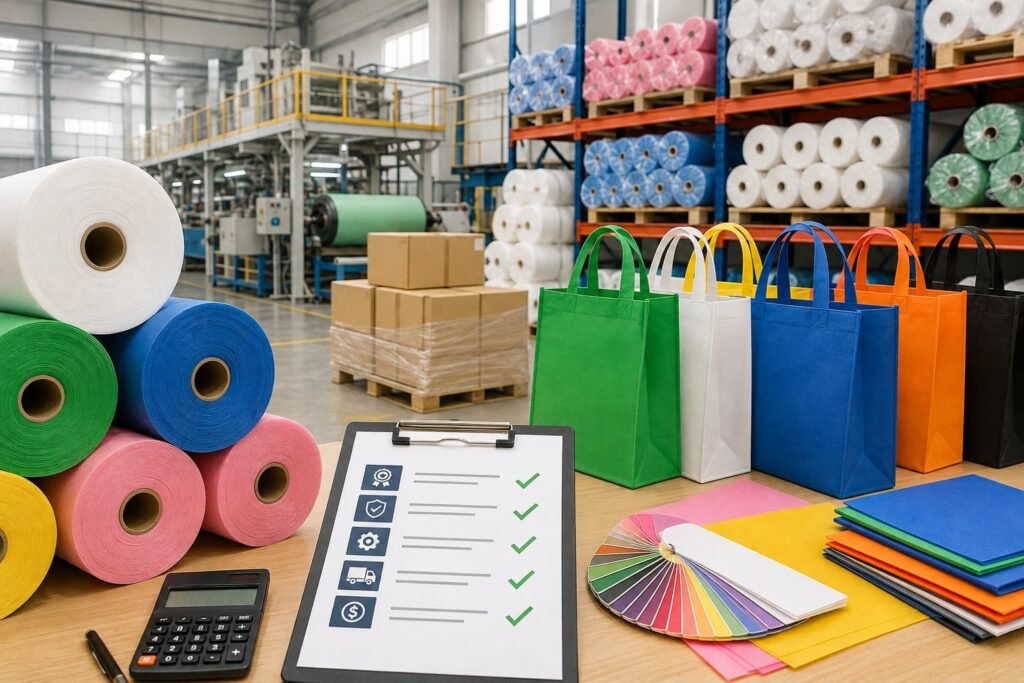
Supplier Evaluation Checklist
Before signing a long-term agreement with a non woven bag raw material supplier, check the following:
- Production capacity – Check the supplier’s monthly production volume and number of machines. Make sure it matches your expected order size.
- QC process – Look for a proper inspection system, including in-line checks and pre-shipment inspection reports.
- Certifications – ISO 9001 should be a starting point. Depending on your market, you may also need REACH or OEKO-TEX.
- Customization support – Confirm that the supplier can provide the colors, GSM range, and printing methods you need.
- Export experience – Check whether the supplier understands the import documents and restricted-substance requirements for your destination country.
- Batch consistency – Ask for samples from different production runs rather than judging quality from only one sample.
A supplier that meets these requirements may be worth paying slightly more for. The money saved by choosing a cheaper supplier can quickly disappear if you receive a rejected or inconsistent shipment.
Packaging, Storage & Logistics
The way fabric is packaged and stored can affect its quality and usable life.
Packaging: Non-woven fabric rolls are usually wrapped in moisture-resistant plastic around a cardboard or wooden core. They may then be placed on pallets and shrink-wrapped for container shipping. Ask whether the supplier protects the roll edges because exposed edges can easily get damaged during transportation.
Storage: Keep rolls in a dry, covered warehouse and away from direct sunlight. UV exposure can gradually reduce the strength of PP fibers. Cotton and jute need extra care because moisture can lead to mildew. Also, avoid stacking pallets higher than the supplier recommends because too much weight can damage the roll cores or change the fabric width.
Logistics: 20ft and 40ft containers are commonly used for sea freight. The weight and diameter of the rolls affect how much material can fit inside a container, so ask your supplier for loading details before confirming your order. Use a first-in-first-out system for inventory, especially for cotton and jute, which generally need more careful storage than PP or RPET.
Poor packaging, storage, or handling can result in a significant amount of material being damaged before it even reaches production.
Conclusion
Choosing the right bag manufacturing material is about finding the right balance between cost, durability, printing quality, and sustainability. There is no single material that works best for every type of bag.
PP spunbond is a practical and affordable choice for many everyday bags. Laminated non-woven is useful when you need better printing and a more premium look. RPET is a good option when recycled content is important, while cotton and jute are popular for premium and natural-looking bags.
The supplier you choose is just as important as the material. A dependable non woven bag raw material supplier should be able to provide consistent quality, test reports, certificates, and physical samples.
If you are ready to start sourcing, request samples from two or three qualified suppliers before placing your purchase order. It is one of the easiest ways to compare quality and avoid problems later.
FAQs
What is the best raw material for reusable bags?
It depends on how you plan to use the bag. PP spunbond and laminated non-woven are good options for everyday retail bags. RPET works well for brands that want to highlight recycled content. Cotton and jute are better suited to premium and natural-looking reusable bags.
Which GSM is ideal for shopping bags?
For most retail shopping bags, 80–100 GSM is a good range. Lightweight promotional bags usually use 60–80 GSM, while heavy-duty grocery and e-commerce bags may use 100–150+ GSM.
How do I verify raw material quality?
Check the actual GSM, tensile strength, colorfastness, roll width, and fabric consistency. For RPET, also ask for documents that confirm the recycled content. It is also a good idea to compare samples from different production batches.
What certifications should a raw material supplier have?
ISO 9001 is a good starting point for quality management. Depending on your target market and product, you may also need REACH compliance, OEKO-TEX Standard 100, and independent SGS or equivalent laboratory test reports.
How are non woven fabric rolls packaged?
Non-woven fabric rolls are usually wrapped in moisture-resistant plastic around a cardboard or wooden core. They may then be placed on pallets and shrink-wrapped for container shipping. It is worth checking whether the roll edges are protected during transportation.