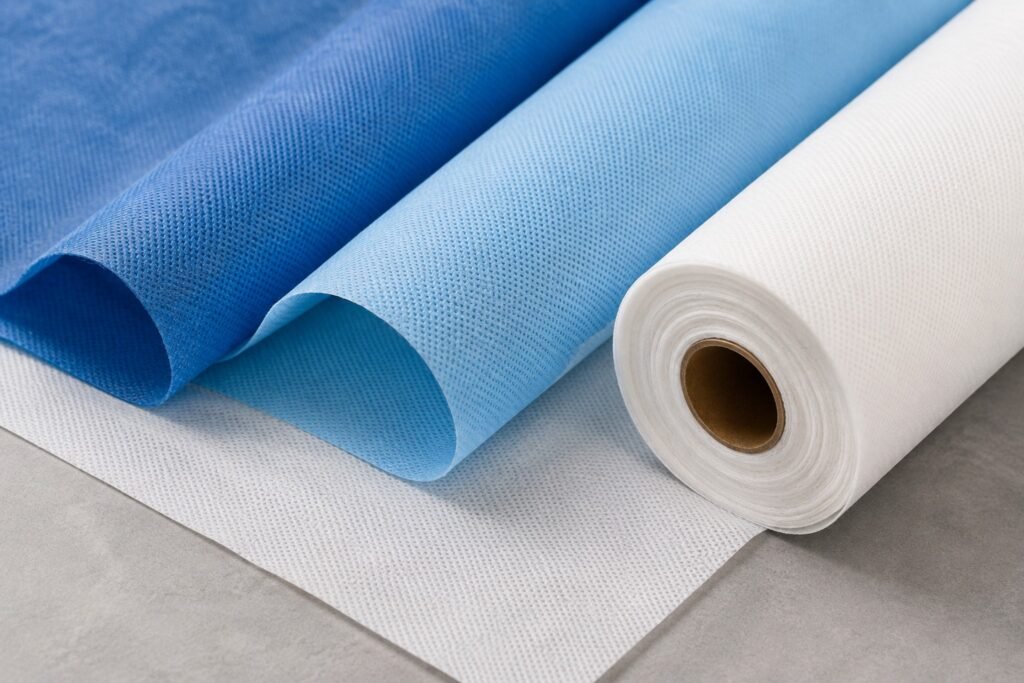
Take a look at the inside of any surgical gown, shopping bag, or crop cover, and there is a large chance it features the same fabric doing work in the background. The popularity of polypropylene fabric has increased over time in the medical, hygiene, agriculture, and packaging industries, where cost efficiency and quality are paramount to wholesale buyers. However, not every fabric is the same, and not every manufacturer will give the same results. Thus, it is crucial to pick the right one. This guide describes what this type of fabric is, how it is produced, what technology and GSM options exist, and what to double-check before placing a bulk order with a polypropylene nonwoven fabric manufacturer.
What Is Polypropylene Nonwoven Fabric?
Polypropylene nonwoven fabric refers to a synthetic material that has been manufactured by joining together polypropylene fibres adhesively, so there has been no need to use weaving or knitting, which has resulted in a very durable, thin, and breathable structure. It must be said that the manufacturing process, namely bonding, consists of using heat, pressure, or mechanical entanglement and makes it possible to fabricate fabric from fibre without spinning and weaving. More importantly, the gained material has already been proven to be essential for the present-day industrial field, as it combines durability and breathability at a rather low cost, which other materials cannot achieve.
How Polypropylene Nonwoven Fabric Is Manufactured
Manufacturing remains a systematic procedure from the beginning of the product until the final product is formed. Initially, the polypropylene resin is melted and goes through die-extrusion, getting into a fine mesh. This net is built with the principle of random placement on the moving conveyor belt. From here, it becomes possible to use heat, pressure, or needle punching (often referred to as the “spunbond process”) to make a solid, single sheet of fabric. Thereafter, the material undergoes testing regarding its GSM, tensile strength, and uniformity before being packed and shipped in rolls to be sold.
Types of PP Nonwoven Fabric Technologies
The type of manufacturing technology influences the strength and filtration characteristics of the fabric.
| Technology | Key Strength | Common Use Case |
| Spunbond (S) | High tensile strength | Bags, agriculture covers, furniture |
| Meltblown (M) | High filtration | Masks, medical filters |
| SMS | Strength + filtration | Surgical gowns, protective wear |
| SMMS | Enhanced filtration | Medical-grade PPE, industrial filters |
| Spunlace | Soft, absorbent | Wipes, hygiene products |
In addition to the manufacturing technology, the GSM (grams per square metre) indicates the weight and strength of the fabric. The lighter 10-25 GSM fabric is appropriate for medical masks and hygiene products, while the fabric weighing 50-80 GSM is standard in shopping bags and promotional ones. Lastly, heavier fabric (80 GSM and above) is used for furniture lining and industrial applications.
Material Properties and Performance Benefits
Polypropylene nonwoven fabric holds unique significance on the industrial front, as it contains many useful properties that no other equivalent material can replicate at a competitive cost:
- Lightweight yet strong: It has high tensile strength with its weight; hence, it can be easily transported and handled in bulk.
- Breathable: It allows the air and vapour to move freely through it while still preventing the movement of particles, thus making it suitable for use in the medical and agricultural fields.
- Water-resistant: It is inherently water-repellent, making additional protective coatings unnecessary in several applications.
- Chemical resistant: It is resistant to most acids, bases, and solvents, enabling its use in industrial and protective environments.
- Non-toxic and hypoallergenic: It is free from any harmful substances, thus enabling its use in medical and hygienic products.
- Cost-effective: It is cheaper than the woven cloth alternative but provides greater strength; therefore, it is a leader in the category of disposable and semi-durable products.
How to Choose the Best Polypropylene Nonwoven Fabric Manufacturer
Supplier Evaluation Check List
- Production capacity: Do they have the production capacity to deliver what you need and within your deadlines?
- Available Technology: Spunbond, SMS, SMMS, etc.
- Certification of the supplier: ISO, OEKO-TEX, or industry-relevant
- Sample availability before bulk commitment
- Customisation: GSM, colour, and width.
- Pricing transparency: clear, volume-based costing
Quality Testing Every Buyer Should Verify
So, before placing a large order, buyers should verify that the manufacturer conducts the following tests. Ideally, these should be supported by test reports or third-party lab results.
- Tensile strength testing confirms that the fabric will not tear during transportation or use.
- GSM consistency testing is used to check the weight of the fabric and also to ensure that it is uniform throughout the roll.
- Air permeability testing for fabrics made for medical use or filtration, where breathability affects the performance.
- Colorfastness testing for fabrics that are printed or dyed and need to check how far the fabric is resistant to fading under light and handling
Bulk buyers often ask for a pre-shipment inspection report before leaving the factory to eliminate the inconsistency before shipment.
Certifications & Compliance Standards
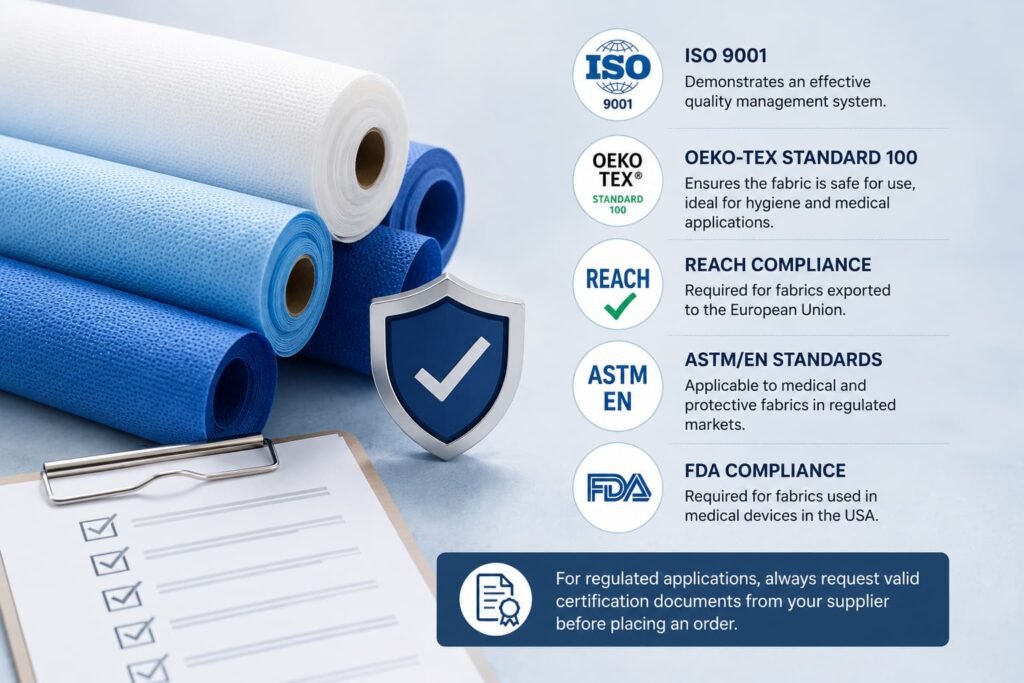
Certifications are determined based on the use of a product and on its targeted market. Buyers are recommended to check for the following alternatives before placing an order:
- ISO 9001 demonstrates that a manufacturer has an effective system of quality management.
- OEKO-TEX Standard 100 means that the fabric is safe for use, which is crucial for hygiene and medical purposes.
- REACH compliance applies to fabrics made for export into the EU.
- ASTM/EN standards apply to medical and protective fabric in regulated markets.
- FDA compliance applies to fabrics used in medical devices in the USA.
Buyers looking for supplies for regulated sectors are advised to ask manufacturers for documentation before making any decisions, rather than relying on marketing statements.
Bulk Procurement Process
Acquiring polypropylene non-woven fabric in large quantities usually follows a standardised sequence comprised of seven steps:
- Inquiry
- Sample
- Testing
- Quote
- Production
- Inspection
- Dispatch
Everything starts with a simple buyer inquiry where the buyer tells the manufacturer exactly what they need, like GSM, width, type of technology, and quantity required by the buyer. The manufacturer sends the sample to the buyer for independent testing, which is conducted based on the requirements of the buyer. Once the specifications are finalised, a formal quotation process starts based on the scale and variations involved in the order, allowing production to begin. Before dispatching, a pre-shipment inspection verifies the accuracy of the order, and the order is then packaged for dispatch.
Packaging, Storage & Logistics
Typically, fabric is supplied in rolls, covered to avoid humidity and dust, and kept on pallets before shipping. Storage conditions have to be dry and free from too much sunlight, as UV rays affect polypropylene fibres. When it comes to worldwide shipping, it’s important to verify the capacity of the cargo container, Incoterms (FOB, CIF, and EXW), and the time frame from the production process to the shipping process.
Conclusion
Polypropylene nonwoven fabric is a material providing numerous options for clients in the medical, packaging, agricultural, and industrial fields. Successful bulk sourcing of polypropylene nonwoven fabric requires matching your technical requirements with the correct GSM (grams per square metre) and carefully evaluating the manufacturer’s certifications, sample quality, and overall production capacity.
Read also:
Frequently Asked Questions
What is polypropylene nonwoven fabric?
PP nonwoven is a type of synthetic fabric that is produced by placing polypropylene fibres in combination with each other by means of pressure or heat.
How do I choose a reliable manufacturer?
This fabric is manufactured by extruding the melted plastic into fibers, which are bonded into a web by using spunbond technology, followed by the process of inspection and winding.
Which GSM is best for shopping bags?
The range of 50-80 would be the most appropriate because it offers appropriate stiffness as well as cost effectiveness.
Is polypropylene nonwoven fabric recyclable?
PP nonwoven fabric is used for different industries such as medical and hygiene, packaging, agriculture, automotive, furniture, and geotextile/construction ones.
How do I choose a reliable manufacturer?
Polypropylene is a thermoplastic material that can be recycled, though recyclability in practice depends on regional recycling infrastructure.
How do I choose a reliable manufacturer?
Evaluate the production capacity of the manufacturing plant, technology type, certifications, availability of samples, customisation opportunities, and pricing transparency.